Wednesday, September 21, 2011

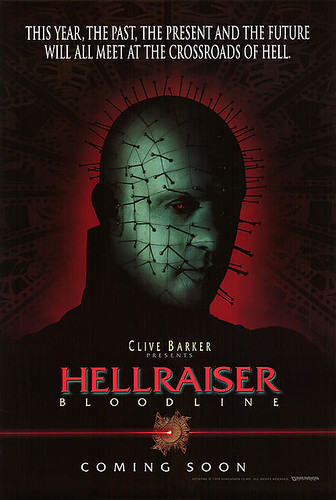
Hellraiser: Bloodline (1996)


The Movie: In the year 2127, aboard the Space Station Minos; the station’s builder, Paul Merchant (Bruce Ramsay, who also plays his ancestors in this movie) works on a mysterious project involving a familiar (at least to those who watch this movie series) box. However, he is interrupted by a group of soldiers. His recent behavior, evacuating the station, re-routing the power, has worried the corporation that owns the structure. The soldiers, led by the psychiatrist Rimmer (Christine Harnos), have been sent to relieve Merchant of his command and determine the extent of his insanity.

Desperate to make her understand the importance of what he is doing, Merchant explains his family history to Rimmer. In the Eighteenth Century an ancestor of his, a toymaker named Phillip L’Merchant, was commissioned by Duc de L’Isle (Mickey Cottrell), a degenerate aristocrat and black magician, to make a box. He then discovered what the box is for; as the magician and his apprentice, Jacques (Adam Scott), killed a girl they lured to their mansion and used her skin to house the demon princess Angelique (Valentina Vargas), who they employed the box to summon.

Guilt-stricken over what he had unleashed, L’Merchant started a design for a device to destroy the demons his box summoned. Unfortunately, he was caught when he attempted to steal the box back and killed by Angelique. He left behind a pregnant wife, but his bloodline was forever cursed by the incident; its fate entangled with that of the box.

In 1996, John Merchant was a very talented and well-off architect with a wife (Kim Myers of A Nightmare on Elm Street 2) and young son. Unfortunately, his most recent and celebrated work was the office building that we saw at the end of Hellraiser 3: Hell on Earth, its design definitely influenced by the puzzle box. Worse, he started suffering graphic dreams about Angelique; and the demoness became aware of him and his work. Things went pear-shaped when she turned up in person.

Using a man she picked up as a sacrifice, Angelique recovered the box from the building’s foundations and summoned the arch-demon “Pinhead” (Doug Bradley in his iconic role) to Earth. Unfortunately for her, Hell changed a lot since she was last there, and Pinhead had his own ideas about how to get Merchant to finish opening a permanent portal. Unfortunately for Merchant and his family, they were placed firmly in the middle of this power struggle. John’s attempt to employ his ancestor’s plan against the demons failed, and he got killed; although his wife was able to send them back to Hell.

Now, Paul has been having the dreams; and he has resolved to finish his ancestor’s work and sever the tie between his bloodline and Hell. He used L’Merchant’s plans to build the space station as a huge trap for the demons. Already his plan is in motion, but unfortunately it was interrupted by the arrival of the soldiers. Now the demons are loose on the station…

The Review:

Hell is more ordered since your time, Princess; and much less amusing.”
-Pinhead

I often get asked why I enjoy the horror genre so much. It’s a legitimate question, hence this current double feature. In reviewing these two movies, I seek to explore what, exactly, it is that I get out of horror.

At its core, the horror genre is about an unpleasant little truth that all of us have to face at some point in our lives; we are not in control. Horror stories always center around the protagonists finding themselves in a situation that is outside of their immediate control, and what, if anything, they do to try to gain that control back. In an uncertain world, it can be greatly comforting to vicariously deal with that uncertainty. It can also be immensely cathartic because, unlike the “Real World,” in genre horror sometimes the evil is defeated, if only for a short while.

Believe it or not, Hellraiser: Bloodline is a movie that I find extremely comforting, and that I watch sometimes when I feel the need for something uplifting. The simple reason why is pretty much expounded upon above; it is a movie about a man who seeks to take back his life from the horrors that are attached to it. What’s more, the ways that said horrors are attached to his life in the first place are ones I can identify with on some level.

The theme of family and lineage is one that particularly resonates with me. As I’m sure we’re all well aware of, family is a mixed blessing at the very best of times. On the plus side, you are forever part of something and nothing you do can ever separate you from it completely. On the down side however, you are forever part of something and nothing you do can ever separate you from it completely.

Even the very best and healthiest of families have dark shadows, whether or not its members are consciously aware of them. The thing about a lineage is you never actually choose to be a part of it; which means that you are going to be affected by things you never had anything to do with in the first place. Exodus 34-7 reads: “I will visit the iniquity of the fathers unto the children, unto the children’s children, unto the third and fourth generations.” Now I can remember a story I read a long time ago where the hero, reflecting upon his own problems, thinks of this verse. He then comments that he doesn’t feel that it is the ravings of an evil god, but merely an observation on how long the repercussions of a destructive act can resonate.

There is a lot of truth to this point of view. Now don’t get me wrong, I love my own family; and in many ways I am extremely lucky in that regard. However, as I have learned more and more about my parents’ families since high school, I have come to realize certain things. Among others, that familial issues from three or four generations ago are still affecting my parents, and by extension myself and my two siblings; and will probably continue to influence any children we might have.

It gets even worse when you start on genetic lineage. As our understanding of genetics grows, you have to wonder how much control you actually have over who you are and what kind of life you lead. Having come into several genetic inheritances over the past decade, I can attest that it can be every bit as bad as a demonic curse on the family line. In fact, sometimes I cannot help but wonder if I wouldn’t prefer the demons. So as you can see, I greatly identify with Paul Merchant and his ancestors. What’s more, the idea of separating oneself from one’s genetic heritage, whether it’s a demonic curse or a tendency towards cancer, is one that greatly appeals to me.

Hellraiser: Bloodline was not well received, and I can see what some of the reasons why are. First of all is in the treatment of the Cenobites; as presented in this movie they fall far afield of Clive Barker’s original vision of them. In the original novella they were not simple demons from Hell at all. Instead, they were human beings who figured out how to lock themselves away in their own pocket dimension so that they could experiment with pleasure and sensation. Unfortunately, an eternity of these experimentations combined with no limits on what they can do have turned them into serious sado-masochists.

What’s more, in their original guise the Cenobites are not evil; or at least on a black and white scale they would be a very dark shade of grey. They have a sense of honor and justice, twisted though it might be. They have no real desire to interact with humanity, preferring to stay in their own realm flagellating each other. Most importantly, they don’t torture people out of any real cruelty; their sensations of pleasure and pain are so screwed up that they think they’re giving their victims what they truly want.

The cosmology of Bloodline is very different, but I still find it fascinating. The vision of Hell that it presents is one that I find refreshingly different, and extremely disturbing. The common perception of Hell is of a chaotic place; one of dark temptations where the demons, at least, live in a state of perverse glee at the torture of their human victims. Angelique is definitely a demon of that brand of Hell, a tempter and a promiser of dark pleasures.

However, when Angelique calls up “Pinhead” for the first time, her reaction to his appearance tells us plainly that he’s not what she expected. His explanation (see the quote I begin this review with), and his subsequent actions and philosophy suggest just how far it has left her behind in her time on Earth. The Hell insinuated by Bloodline is not a demonic playground of perverse and sadistic delights, but an impersonal corporate machine. It exists and functions solely for its own existence and function, and even the minions that keep it running get no real pleasure or reward for their efforts. Take note just how Angelique has changed when she reappears in the last chapter of the movie, after about a century or two in this new Hell.

The two main villains are definitely the best characters in the movie, due largely to the actors who play them. Vargas is wonderful as a succubus; usually sexy, but able to be terrifying and threatening at the same time. Bradley, as usual, has such presence that he commands the lion’s share of attention whenever he’s on screen. His presentation of this Lord of the Damned is imperious, threatening, and not a little formidable.

What’s more, Bradley adds a bit more personality to the role than it might otherwise have. Pinhead in Bloodline displays a sense of humor; not the slapstick one that was justifiably derided in the previous sequel, but an ironic one so dry and deadpan it’s easy to miss. Also, Bradley is able to convey large amounts of dialogue with just his facial expressions. Probably my favorite part of this film is a brief shot of his face at the end of the second chapter, when he is being sucked back to Hell but just before he lets out the inevitable scream of impotent thwarted rage, where his expression says very clearly “Brother, here we go again. Sigh, might as well get the formalities out of the way.”

Another reason Bloodline got derided by audiences was the space setting. True, it was made during a period where just about every flagging horror franchise was placing their villain in outer space. However, unlike the other franchises this movie’s use of the setting actually works. For one thing, the space setting is only a very small part of the movie; for another, the space station comes across as a rather fitting setting for the Cenobites.

Also, the setting provides one of the more intriguing aspects of the storyline; in the form of the hero’s one advantage against his foes. Paul never actually confronts the demons directly; undoubtedly having learned from his ancestors’ examples that going toe to toe with them is suicide. When he solves the box he uses a remote controlled robot to do it; and the demons are obviously puzzled when they arrive. Likewise, in the two confrontations he has with Pinhead, Paul is able to use the stations tech to distract the demon from what he is actually doing. This provides the setup for the climax, which I think is very well done.

Admittedly, there are a few criticisms that Bloodline is deserving of. Most of the rest of the cast isn’t as good as they should be. Ramsay’s talents range from not great to adequate, and Harnos really doesn’t provide much at all.
However, I think that this movie’s biggest flaw lies at the feet of its producers.

The man who wrote and directed it had a very ambitious storyline laid out, but the studio changed much of the script behind his back. Many of the good points come across as not as good as they should have been, largely because of unreached potential and the sense that something important is missing. Likewise, there are a few scenes that were obviously just put in because somebody decided that they needed to be there for it to be a horror movie. The most grievous example is where the soldiers are being picked off just before the climax. We’re never given the chance to know them as human beings, and the scenes of them falling prey to the demons mostly play out like an assembly line.

But for all its flaws, I still rather like Hellraiser: Bloodline. It’s not the best movie ever made, but it’s definitely worth the occasional watch and has its good points. Most of all, the storyline itself is one that I, personally, find rather uplifting and inspiring; and the longer I live the more I find uplifting and inspiring to be necessary, whatever the source.

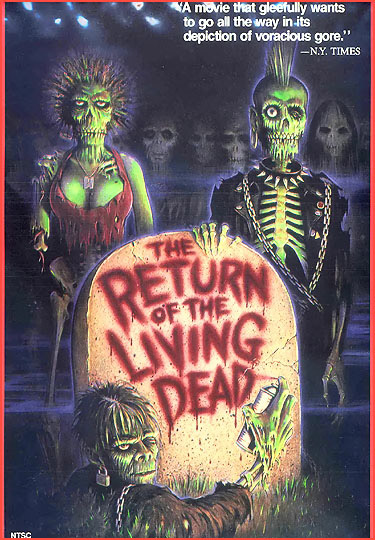
Return of the Living Dead (1985)


The Movie: It’s Fourth of July weekend and Frank (James Karen of Mulholland Drive and Poltergeist), of the Uneeda Medical Supply Warehouse in Louisville Kentucky, is staying after work to show Freddy (Thom Mathews), the new stock boy, the ropes. After seeing the wonders of the place; the skeletons, the prosthetics, the split dogs sold to veterinarian schools, the single human cadaver currently in the freezer; Freddy asks Frank what the weirdest thing he’s ever seen on the job is. Frank tells him.

Apparently the old horror movie Night of the Living Dead is based on a real event. The army commissioned the Darrow Chemical Company to create a chemical, 345 Trioxin, to use in the growing War on Drugs. A canister spilled and its contents seeped into the morgue, causing some of the corpses to move around. The army packed up the animate corpses and contaminated dirt and loaded them into canisters to be shipped back to Darrow Chemical for testing. However, in a “typical army fuck-up,” the canisters were mixed up with another order and shipped to the Uneeda warehouse instead. They’ve sat in the basement for almost a decade and a half now.

Of course, Frank offers to show Freddy the canisters. To demonstrate how sturdy the Army Core of Engineer’s work is, Frank slaps one of the canisters, immediately causing it to rupture. Both men get a face-full of Trioxin gas and pass out, while the ventilation system disperses the gas throughout the warehouse. When they wake up, Frank and Freddy are feeling extremely sick; and the dead inventory are all much more lively now, particularly the corpse in the deep freeze.

Frank calls Burt (the venerable and prolific Clu Gulager), the owner of the warehouse, about the problem. The three men start by trying to destroy the animated corpse, but that task is nowhere near as easy as the original movie would have you believe. All they manage is to restrain it and cut it into many squirming pieces. But Burt gets another idea, take their problem to his friend Ernie (Don Calfa, of Weekend at Bernie’s and Chopper Chicks in Zombietown), the mortician of the Resurrection Cemetery funeral home just across the street. Ernie runs a crematorium, and maybe they could use it to destroy all the evidence; problem solved.

Ernie is talked into it, and the body goes up in smoke. Unfortunately that brings a whole new set of unforeseen complications; the corpse is saturated with Trioxin. The toxic smoke seeds the clouds, causing a massive downpour on the cemetery. Freddy’s girlfriend Tina (Beverly Randolph) and their friends are partying in the cemetery, waiting for him to get off work. This puts them in the perfect position to witness the acidic rainfall and the cemetery living up to its name. The animated corpses that result are not only nearly indestructible, but they are also fast, agile, and intelligent. They seek to eat the brains of the living, because the endorphins mask the pain of rotting for a while.

As if that wasn’t bad enough, Freddy and Frank aren’t doing too well either. In fact, the paramedics called in say that they’re technically dead, except that they’re still conscious. There is one possible solution, the contact number on the army canisters. However, this being the organization that had the Trioxin created in the first place, it is doubtful their solution will be pleasing for those involved…

The Review:

"The events portrayed in this film are all true. The names are real names of real people and real organizations"
-Opening Scrawl

Here is part two of my double feature on what I get out of the horror genre. As I mentioned in my previous review, I find the horror genre extremely cathartic because it vicariously explores the theme of not being in control of one’s life. However, there is more than one way to achieve that catharsis. This film is probably the opposite side of the coin in that regard from the one I previously reviewed. Whereas Hellraiser: Bloodline is a movie that I watch when I need some hope that it is possible to regain control of a seemingly hopeless situation; Return of the Living Dead is what I watch when I’m in the mood to explore and revel in just how bad it could possibly get.

Return of the Living Dead is one of those rare horror-comedies that manages to get it right. In fact, for me it stands alongside Re-animator at the pinnacle of successful horror-comedies. Return’s humor is of the blackest sort; it’s the laugh that comes from knowing that it’s all going to Hell, but appreciating how ridiculous it all is anyway. In fact, Return employs its humor and horror elements in a way that I rarely see used, much less used successfully; they feed into each other. The more horrifying things get, the more comically absurd they get, and vice versa. In particular, the scenes where Frank and Freddy discover what has happened with the split dogs, and where they and Burt are trying unsuccessfully to destroy the first re-animated cadaver, are ones where I find myself simultaneously laughing and cringing.

The driving theme of Return of the Living Dead can probably be summed up thusly: it may not be as bad as it could possibly get, but it soon will be. The whole plot is basically one long series of examples of Murphy’s Law in action. No matter what the situation, or how it might first appear, things rapidly go all wrong. Just in the pre-credits section, where Frank first ruptures the canister by slapping it, all the way to the apocalyptic ending (which, the movie makes clear, is very far away from the end of the actual event); we are placed in an atmosphere where we know for certain that nothing will turn out right. Even in the minor events, a feeling of doom and gloom hangs over everything, and we know instinctively that they will end very badly for our protagonists.

And yet despite the atmosphere of doom and gloom, we cannot help but laugh. Terrifying as it is, there is just something really absurd about the world we know coming crashing down. Some of the humor is very blatant; the eye chart in the Uneeda warehouse office that reads “Burt is a slave driver and a son of a bitch…” (it goes on but I can’t read the rest), for example. However, an equal amount of it is very deadpan, sometimes to the point where you might miss it if you’re not paying attention.

Return of the Living Dead is very much a product of its time; the dark depths of the Reagan Era when the twin horrors of Mutually Assured (nuclear) Destruction and Right-wing insanity hung over this country like a cloud of doom. However, more and more I find it fits equally well in this day and age, what with the ongoing “War on Terror.” Having just passed the tenth anniversary of the September 11 terrorist attacks as of this writing; I cannot help but reflect how our foreign policy has gone in a full circle since that terrible event, greatly compounding the damage from it. But that’s a rant I’ll spare you for another time.

Anyway, due to the political influences on this movie resulting from the era in which it was made, there are all sorts of nasty satirical touches in it. The fact that the two main authority figures are named Burt and Ernie, for example, cannot be a coincidence. There’s also the fact that Ernie is listening to Wagner when we first meet him; and that he carries a handgun which he pulls automatically at any excuse. Of course, it poses more potential harm to him and the other protagonists than it ever does to the true threat. And of course, finally, there is the whole theme of “the Proper Authorities are not your friends.” Admittedly it does come straight from the Romero movies that Return is paying homage to, but it also fits right in to the political atmosphere of the time.

Probably the movie’s greatest strength is its cast and characters. All of the characters, while lightly sketched for the most part, come across as at least somewhat believable as a fully fleshed-out human being. There are no square-jawed heroes in this flick, no wise authority figures who have the answer. Instead , we have completely ordinary human beings caught in an extremely extraordinary situation that they have almost no frame of reference for. And, unlike most horror movies, they act as real people would. All the characters do stupid things, but their actions are plausibly stupid, not moronically suicidal. Likewise all of the characters freak out about the situation at some point, but most also have something to contribute to the attempt at a solution as well. The fact that they are completely powerless to affect it at all is hardly their fault.

All of the cast do a great job of portraying a believable human being. Aside from the characters I just mentioned, even the ones playing the punks of Freddy and Tina’s group of friends come across as individuals. Mark Venturini’s Suicide may come off as a “designated asshole” archetype of the genre, but his dialogue reveals that there is legitimate reason for this behavior; and he even shows a bit of nobility when he (albeit unintentionally) sacrifices himself trying to save Tina. The lovely Linnea Quigley, in the role that earned her her crown as Queen of the Scream Queens; is very convincing as the tough-talking, death-obsessed Trash, whose façade collapses as soon as the fewmats really start hitting the windmill. It should also be said that the scene nearly everyone takes away from this movie, with good reason, is the one where she does a striptease on top of a crypt. I also must add that she's probably my favorite movie zombie because she gives so much personality and character to the creature. That's a major thing because: 1) Just about every zombie in this movie has some personality and/or character and 2) She's probably the only one who never talks or makes noise.

In general, the special effects, while coming across as fake-looking in a few parts, are mostly top notch. If you aren’t inured to gore, don’t watch this movie while eating. The soundtrack is wonderful; the punk-rock songs used fully complimenting the action on screen. The script is very well written; and the movie as a whole is so full of little touches, such as the eye chart I mentioned above, that it’s impossible to catch them all on a single viewing. Above all, there is a manic energy about the whole thing that drives you inexorably to its conclusion. And as for said conclusion; while “wait, it’s not over yet” type endings are par for the course for the horror genre, this one flows organically and legitimately from what has happened earlier in the film.

So in conclusion, Return of the Living Dead is a hell of a movie experience; well written, well casted, and very well made. Hilarious and horrifying, gory and gleeful, and driven by a demented yet irresistible energy; never has watching the world get dragged to Hell been this much fun.

Sunday, August 21, 2011

Cast a Deadly Spell (1991)


The Movie: The year is 1948 and everyone uses magic. Well, not quite everyone. Detective H. Phillip Lovecraft (the prolific Fred Ward) absolutely refuses to use it, despite its constant presence and the pressure from everyone around him. That refusal is going to severely handicap him in his latest case.

Uber-rich scholar Amos Hackshaw (David Warner, of many films including the Omen and In the Mouth of Madness) wants Lovecraft to hunt down some stolen property for him. His former chauffer Larry Willis (Lee Tergesen) has stolen the prime book in his collection; a volume on esoteric magics called the Necronomicon. What’s more, Hackshaw needs it back by midnight two nights hence.

The first lead Lovecraft gets a hold of leads him to the club the Dunwich Room; which it turns out is owned by Harry Bordon (Clancy Brown, from Starship Troopers and Highlander, as well as the T.V. series Carnivale), a two-bit crime boss who also happens to be Phil’s old partner on the police force. Even more awkward is the presence of Connie Stone (the prolific Julianne Moore), the femme fatale headliner for the club and Phil’s ex-girlfriend. The more he searches, the more Phil gets drawn into the sinister web of intrigue building up around the book; having to contend with zombie leg breakers, gargoyle hit men, summoned demons, and Olivia (Alexandra Powers), Hackshaw’s hot-to-trot sixteen year-old daughter. All of this is building up to a dark ritual that may destroy the world.

Phil does, however, have an ally in his landlady, Mrs. Kropotkin (Arnetia Walker); a no-nonsense Voudoun practicing witch. Kropotkin is determined to get Phil through the mess with the Necronomicon intact; and the fact that her help isn’t exactly desired is entirely beside the point. However, even with her unwanted assistance; can Phil Lovecraft stand against the rising darkness?

The Review:

It started with a woman. It always starts with a woman…"

I am very tempted to say “not bad for a made-for-TV movie.” However, I will not say that; as it would be both a major understatement and a grave disservice to the movie in question. Cast a Deadly Spell is an HBO made movie, and it’s pretty damn good. I won’t say it’s the best movie ever made; or anything near. Still, it is very well made and, above all, it is a lot of fun.

In essence, Cast a Deadly Spell is two things; it is a noir detective story, and it is a tribute to the great horror author H.P. Lovecraft, in that order. In the latter category, it is only really a tribute. Various names from Lovecraft’s work appear, as does his famous plot formula of black magicians seeking to summon forgotten evil gods back into our world. Cthulhu, Lovecraft’s most famous creation, makes a brief appearance at the climax. And finally, of course, the author’s name is present in the name of our hero.

However, it is as a noir that Cast a Deadly Spell really works. Except for the inclusion of the supernatural, it would fit right into the classic noir’s of the 1940s. All the archetypes are here; the hardboiled detective who won’t compromise his principals, the rich degenerate, the gangster, the femme fatale. The usual themes are very much present as well. The theme of getting by without selling one’s soul is our hero’s primary motivation; albeit presented much more literally than usual. Then again, I find myself more of the opinion as time goes on that Faust got a much better deal than contemporary society is willing to offer me, or most other people. There is also the important theme of moral ambiguity; particularly where a truly immoral act is what winds up saving the day.

The plot’s structure also lines up perfectly with the plot of a classic noir detective story. In all the major particulars, the plot is by the numbers. However, it’s in the little details where this movie comes into its own. The world which the characters inhabit is beautifully crafted, to the point where one could almost believe that it exists. The inclusion of magic and the supernatural also allows some truly fun little details; such as the gremlin infested boarding house where Lovecraft begins his investigation, or the scene at the police station where the hooker in the holding cell reveals a set of vampire fangs. These are just little details that aren’t important to the main plot, but they help reinforce the sense of a living, breathing world.

I particularly admire how the movie handles the subject of magic, itself. As a student of mythology and folklore for most of my life, I have come across many systems of magic. Now, despite what Disney has led us to believe, there is not a single pre-twentieth century system of magic that is simply “wave the wand, say the words, and ‘poof’ it happens.” In fact, every system of magic I have come across is every bit as cause and effect as contemporary Western science. Admittedly it usually works along different principals; Voodoun magic, for example, involves knowing who the right spirits are for the situation and how to get in their good graces; but there is always a system behind it.

Now, Cast a Deadly Spell never actually explains the system behind its magic, but it presents it in a way to suggest that there is something behind it. If you watch the magic-using characters, you will often notice them doing some seemingly odd, and or pointless gesture before the actual magic starts. As an example, in one scene where Harry has his henchman, Tugwell (Raymond O’ Conner of Halloween 4 and Doctor Alien), pay off a flunky that they intend to double cross; Tugwell sucks on the little package that has his “payment” inside. A short time after, when Tugwell corners him in a public restroom to finish him off, it’s the package and its contents that are used to kill the man, giving him a very nasty death by paper cut.

Another way I think the movie employs the subject of magic very well is how it is presented in society at large. It is clear that in this world, magic is the latest Big Thing, and much like Western science in our world all the way back to the Industrial Revolution, there are good and bad sides to this. On the one hand, there’s no denying that it works. However, much like science, the majority of the characters don’t really understand it even though they use it constantly. In our history there have been many examples of how this state of affairs can be misused and exploited to the advantage of a few individuals; Social Darwinism, Dianetics, and Creationism/Intelligent Design to name but a few. This is echoed in Cast a Deadly Spell with the constant refrain of “it’s the way of the future.” And yet, we can often see the limitations even if the other characters can’t. In one of my favorite scenes, Lovecraft’s case takes him to one of the postwar tract suburbs that were going up at this time in history. The saleslady eagerly emphasizes how they are built entirely by magic; but the zombie workmen demonstrate, far better than any line of dialogue could, how just because something is the latest technique, it doesn’t necessarily make it the best one.

Probably the character with the healthiest attitude toward magic is Mrs. Kropotkin. On the one hand, being a witch herself, she does use it. In fact, the very first thing we see after the credits is her performing a divination ritual. There is also a scene late in the movie where she corner’s Lovecraft, orders him to give her his hand, and then puts a charmed bracelet on it. When he protests that he doesn’t use the stuff, she merely responds “I know, that’s why I locked it on.” Kropotkin then proceeds to tell Lovecraft, rather bluntly, that he is a moron for his attitude toward white magic; but he needs what she is providing him, and she’s going to make sure he gets it, whatever he might think of the arrangement.

On the other hand, Kropotkin, unlike the other magic-using characters we meet, does not feel that magic is an end in and of itself. Her reaction to Lovecraft initially asking her about the Necronomicon makes it clear that there are some lines she will not cross. Probably more notable, she’s probably the only magic-user we never see employing magic for minor tricks like making things float or lighting cigarettes. At the end she is gathering supplies to help Lovecraft with his injuries, and when he asks what’s in one bottle she answers that it’s rubbing alcohol, and gives the caveat “I’m a witch, but I’m not a fanatic.”

I must confess that Mrs. Kropotkin is my favorite character. A large part of it is because Walker does such a wonderful job with the character, but also her relationship with Lovecraft kind of reminds me of my own with my little sister. My sister is a major control freak, but she’s right often enough that it’s dangerous to reject her advice out of hand. I find myself identifying with Lovecraft in the scenes where he deals with Kropotkin; it’s extremely irritating that she sticks her nose in, but he’s always grateful for it in the end.

So, in all, Cast a Deadly Spell is a good movie. One small warning, the box might make you think it’s a lighthearted comedy (that certainly happened with several people I showed it to). It’s not; while it does have a sense of humor it’s mostly a very dry, deadpan one. Still, this movie is a lot of fun and definitely worth watching if you can find it. So why the hell’s it not out on DVD yet?

Monday, August 8, 2011

Repo! The Genetic Opera (2008)


The Movie: In the future, an epidemic of organ failures devastated humanity. Our species was almost wiped out, but for Rotti Largo (Paul Sorvino of GoodFellas and the Leonardo DiCaprio version of Romeo and Juliet). Largo started the company GeneCo, which replaced the problem organs with healthy ones. Cosmetic surgery became very popular as a result. Unfortunately, there is the inevitable Faustian clause to the company’s services; GeneCo was able to use its position to become, essentially, a legal loan-sharking operation. If you are unable to pay up on your new organs, GeneCo will send a repo man to come and repossess the property. It’s every bit as unpleasant as it sounds.

GeneCo also created an extremely addictive painkiller called Zydrate. However, the lowlifes of society have discovered that Zydrate can be extracted from corpses. Combined with GeneCo’s policy on organs, it is insured that a thriving black market makes grave robbing a very profitable enterprise; despite the fact that GeneCo can, and does, legally kill anyone who tries to buy or sell the products illegitimately.

Our story takes place many years after this sorry state of affairs began. On the one hand we have seventeen year-old Shilo Wallace (Alexa Vega, of the Spy Kids movies), who has suffered her whole life from a debilitating blood disease. Her mother died at her birth, and her father, Nathan (Anthony Stewert Head, best known for his role in the Buffy the Vampire Slayer television series); overcome by guilt, grief and obsession, has done his best to keep her locked away from the rest of the world. He’s also been careful to keep his career as a repo man secret from his daughter.

On the other hand we have Mr. Rotti Largo, who has discovered that he is terminally ill. The worst part, for him, is the succession of GeneCo. Rotti does have three children, but they are humiliatingly dysfunctional and, he feels, unfit to inherit. Amber Sweet (the notorious Paris Hilton), is thoroughly addicted to cosmetic surgery and black market Zydrate. Luigi (Bill Moseley of Texas Chansaw Massacre 2 and the Devil’s Rejects), well… let’s just say that to describe him as having anger issues and homicidal tendencies would be grossly understating the issue. Finally, loutish Pavi (Nivek Ogre), has a nasty tendency to, among other things, steal other people’s faces so he can wear them himself.

The two issues collide when Shilo comes to Rotti’s attention. There is far more to her mother’s death than Nathan is willing to admit to, or is even aware of. Also, the two men have a rather nasty history together; far more than that of Nathan working as Rotti’s hatchet man. Rotti sees in Shilo the chance to kill two birds with one stone; find a competent heir for GeneCo, and pay back an old grudge. Unknowingly, Shilo becomes a puppet in a sick game as she desperately tries to find out the truth of her life. It will all come to a head at the big Genetic Opera…

The Movie: For a long time I have had many people telling me I need to see Repo! The Genetic Opera. A friend even loaned me a copy that I had every intention of watching. But you know how it goes; various other things pile up and you keep on putting it off. Finally, I made a point of sitting down to watch. So what was my verdict?

This will probably sound cliché, but Repo! is unlike anything I have ever seen. It consists of elements that would seem to be contradictory, even paradoxically so. Genre wise, Repo! is in turn horror, dystopian science fiction, black comedy/satire, and opera. It is simultaneously beautiful and repulsive, terrifying and gleeful, tragic and perversely hilarious. And yet, all of these disparate elements blend together seamlessly into a mutually coherent whole. This, this movie, is why I consistently search outside the mainstream for my entertainment.

First there is the look of the movie. Repo! employs comic book panels, live action, CGI, and a smidgeon of conventional animation to tell its story. The feel of the setting is mostly Victorian-gothic, and yet the science fiction setting allows it to play with those tropes a bit, throwing delightful bits of anachronism into the mix. In some places, the setting feels removed completely from the conventional time stream. As an example, one of the touches that came to my attention were the portraits of Shilo’s mother that filled her house; they look every bit the stereotype Victorian portrait, except that they are 3D-looking holograms.

Then there’s the music. I, personally, have minimal experience with opera; yet the structure of Repo! fits perfectly the little bit I do know about the art form. Normally I’m not into musicals, but such is the music woven into the makeup of the film that it seems a perfectly natural part of it. Even in a seemingly unsuitable scene for a song number; such as a corporate hatchet man repossessing somebody’s spine, it seems to make perfect sense that said hatchet man would be singing about his situation while he does it.

The final part of Repo! is the cast and characters. While the setup, props and sets and style are all amazing, it is the characters that this film is truly about. Repo! provides us with some truly fascinating individuals (albeit, usually “fascinating” in the exact same way one would find a horrible train wreck fascinating), and it is the people who play them who make the film work. It would not work at all with a less than stellar cast; but fortunately this is never an issue.

It falls to Alexa Vega, as Shilo, to carry most of the film’s weight. All of the major plot points revolve around her as the only true innocent in this twisted web she finds herself trapped in. For the movie to work at all Shilo has to likeable, identifiable and sympathetic. Vega delivers on this in spades. What’s more, I didn’t recognize Vega at all while watching Repo!. There was a small voice in the back of my mind screaming that I should know her from somewhere, but it wasn’t until I saw her name in the ending credits that it clicked. As I’ve mentioned before, I have the utmost respect for actors who can get so far into their role that we forget we are watching them instead of their characters. Vega has talent, and it is my sincere hope that she continues to move on to bigger and better things.

Like so many other people, I mostly know Anthony Head from his role as Rupert Giles in Buffy the Vampire Slayer. However, even in that role he displayed diverse and varied talents. Repo! gives Head a chance to employ them all, something which he never fails to do. Head does a remarkable job of displaying a truly multifaceted character. On the one hand, Nathan Wallace is undeniably a monster; and neither Head nor the script do anything to downplay that. However, he is also a human being, and as we get to know how he became what he is, we find him deserving of our sympathy even as we are repulsed by his actions. This is a very difficult balance to nail accurately, but both Head and the script do just that.

The true villains of this piece are equally captivating. Sorvino is perfect as Rotti, the architect of most of this world’s misery. He is the archetypal corporate gangster; brutal, greedy, vindictive, and completely uncaring about whom he hurts to get what he wants. However, even Rotti isn’t a completely two-dimensional caricature. Amazingly, Rotti Largo is practically tailor made to be a villain that I hate and love to hate; and yet there are a few scenes where a very small part of me cannot help but feel the tiniest bit of sympathy for him. That’s pretty remarkable.

One of the people who suggested this movie to me said that it’s one of the rare instances where I would actually want to see Paris Hilton. Believe it or not (and I still don’t), she was telling the truth. Hilton is great as a spoiled, rich brat. Admittedly, one could make a legitimate argument about typecasting in this case, but the woman also has some talent as a singer. Moseley and Ogre are also good as second-tier villains.

Finally, I would be remiss if I failed to mention Terrance Zdunich in his role as the unnamed criminal (the credits just have him listed as “Graverobber”) who is Repo!’s Greek chorus. The man is definitely a dark and sinister figure, yet he proves to be no actual threat to Shilo. Instead he serves her (and us in the audience) as a guide to the twisted world in which they live. He also helps keep the audience abreast of the major plot developments. Zdunich does a wonderful job; and in some ways reminds me of the M.C. character in Cabaret, who plays a similar role.

In conclusion, Repo! the Genetic Opera is a gory, nightmarish, tragic, hilarious, and very well done example of the art form. It is well put together, with a great cast and script. Truly a work of demented genius, I would love to see more work from the guy who originally created it.

Thursday, July 28, 2011

The Wicker Man (1973)


The Movie: Sergeant Neil Howie of the West Highland Police (television actor Edward Woodward) travels by seaplane to Summerisle, a small island off the coast of Scotland. Howie comes on official business; he has received an anonymous letter about the disappearance of Rowan Morrison (Geraldine Cowper), a local girl. It would appear that a horrible fate may have befallen her, and Sergeant Howie is determined to get to the bottom of it.

But it is not going to be easy. The inhabitants of Summerisle are very unhelpful, and at times even seem to be blocking his investigations. What’s more, Howie is a devout Christian and something of a bigot. The people of Summerisle are openly Pagan, and Sergeant Howie is even more angered and disgusted by their beliefs and lifestyle than he is by the potential fate of the missing girl.

The islanders’ upcoming spring celebration has Howie convinced that a horrible fate awaits Rowan; and he is determined to find her before it happens. Unfortunately, his bigotry and intolerance leaves him blind to the dark destiny that he is being led to himself…

The Review:
"The little old beetle goes 'round and 'round. Always the same way, y'see, until it ends up right up tight to the nail. Poor old thing!"-Daisy Pringle (a little girl at school)

The Wicker Man is a true classic of a movie; one that has received, quite deservingly, much admiration over the years since its release. And yet, it is a film that was almost lost. Throughout the early years of its existence, The Wicker Man was owned by individuals who neither knew nor cared what kind of treasure they had; and it was only through the devotion of the movie’s makers that it has received the recognition it deserves. For all the depressing details, look at the review for this movie on the site And You Call Yourself a Scientist, which you will find on my link to the B-Masters’ Cabal.

Unfortunately, due to this, parts of the original movie were lost. There is a restored version (which, unfortunately, I have yet to see), but even that, I understand, is missing a little bit of the running time. The version I am reviewing is, by necessity, the truncated version of the film. It really says something that even in its truncated state; Wicker Man is still an extremely moving and effective work.

At this point I must warn that to analyze this movie any further, I will have to give some serious spoilers. Admittedly, the big reveal at the end was spoiled for me long before there was an internet (yes, I am that old); and yet I still found the movie incredibly effective. Still, if you haven’t seen Wicker Man; and more so, if you are one of the rare individuals who don’t know how it ends; stop reading this, watch the movie, and then come back to see what I have to say about it. Trust me, you’ll thank yourself later. This is your final warning.

Okay, here we go. In place of the typical horror movie tropes of build-up and then scare; the Wicker Man uses two very clever examples of cinematic sleight of hand to convey its horror. Actually, I don’t think I have ever seen another horror movie that employs the specific techniques Wicker Man does.

The first bit of sleight of hand is with the atmosphere and the build up to the horror. The majority of the running time of the film consists of what seem to be the typical buildups to horror that we would expect. There is the set up, and we go through it waiting for the pay-off; but it always ends up at best, anti-climactic, and at worst a very tasteless joke. As an example, there is a scene late in the film where our “hero” has taken it upon himself to do a house to house search; barging into homes and businesses and opening everything he can find. At one point he opens a wardrobe, and the body of a little girl falls out. However, after he has started to examine her, the “corpse” giggles, gets up, and runs off laughing.

What this does is subconsciously condition the viewer so that eventually, on some level, we expect that nothing serious will happen. This continues to the final build up at the very end, which is the one time the movie plays it straight. Having been conditioned to expect yet another anti-climax, the seriousness of this final outcome packs far more of a punch than it would have if all of the build-ups had paid off like we’d been led to expect.

However, at the same time these anti-climactic help to continuously build a very subtle but palpable tone of unease. From almost the beginning we get the sense of being a traveler in a foreign culture (and make no mistake, Summerisle may be technically under Sergeant Howie’s jurisdiction, but for all intents and purposes it is very much a different country entirely); one that seems oddly familiar and yet disconcertingly alien. While the symbols that are very much in evidence may be known to us, they are consistently outside to cultural context we are used to seeing them in. This sense of the alien combined with the very real fact that a child has disappeared sets a tone of dread; even as we are conditioned not to expect something truly terrible to happen, there is still a part of us expecting it.

The other bit of sleight of hand that makes Wicker Man so effective is in its characters. This is a movie with no true heroes, where all of the individuals we are involved with are disconcertingly ambiguous in their motivations. There are a few elements of Sergeant Howie’s circumstances that evoke our sympathies at first. The sense of being a fish out of water in a strange culture is something all of us can identify with on some level; ditto how galling it is that the locals very clearly don’t take him seriously, and are even blatantly trying to push his buttons much of the time.

However, our sympathy for the good sergeant fades very quickly. Howie proves to be one of those small-minded bigots who is utterly convinced that he, and he alone, has the lock on Truth and faith. What’s more, he feels that it’s his duty to bludgeon them into anyone who thinks differently. And whenever he fails to bludgeon the locals with his religion, he’ll attempt to bludgeon them with his civil authority and his search for Rowan instead. There are also a few parts that reveal him to be a bit of a hypocrite as well. It’s not long before I’m actually praying for something horrible to happen to him.

The locals seem just the opposite. They generally come across as happy and good natured, and at many points it’s hard not to admire and envy their lifestyle. We very quickly grow very sympathetic to their plight of having this asshole outsider barge into their community and attempt to bully them. However, there is that sense of dread we cannot help but feel. There’s also the character of Lord Summerisle (Christopher Lee), the community leader, who it becomes obvious is every bit as bigoted as Howie, just in the opposite direction.

Still, for most of the movie our main feelings tend to be sympathy for the locals and disgust for Sergeant Howie. It’s when we reach the horrifying climax that those opinions are brutally reversed. We may have been praying for something horrible to happen to the sergeant, but he certainly doesn’t deserve what does happen to him. And the villagers, who for the most part come across as, at worst, harmlessly eccentric; suddenly reveal a true and unexpected viciousness.

Probably what makes the Wicker Man most effective is that, aside from the subtly growing unease and the one true scene of horror at the end, it really doesn’t feel like a horror movie at all. Nearly all the movie, including that concluding scene, are in bright sunlight; the setting is a “quaint” little village in the middle of some truly beautiful landscape; and there is much humor and singing throughout it. The interesting thing about the latter two elements is that they do not seem intrusive at all; they are very much a part of the setting.

The singing is a part of the culture depicted, and illustrates the natives’ lifestyles very well (plus gives Howie one more thing to irritate him, what with the ribald and graphically sexual lyrics). In fact, it is a very large part of what I find to be the most effective scene of the movie, where Willow (the lovely Britt Eckland, of Royal Flash), the innkeeper’s daughter, is attempting to seduce the good sergeant in his bed from her room. The song being sung weaves a spell over the proceedings that, combined with the wonderful performances of Ekland and her body double, creates one of the most erotic and arousing scenes I have ever seen on film.

Likewise, the humor adds to the plot and the characters. Probably the part I found funniest was the expression on Sergeant Howie’s face when he steps into the girls’ classroom of the schoolhouse to find their teacher (Diane Cliento) teaching them a lesson on what the maypole represents (hint, it’s a long shaft with a knob on top, and it is a symbol of fertility). And that thing about the humor is that it also really adds to the atmosphere, and helps to throw us further off kilter as we get into what’s really going on.

In conclusion, the Wicker Man is a true movie classic. It is very well made, I cannot think of a single criticism to apply to it; and even in the truncated form which is all that’s been available to most of us for so long, it’s still pretty damn impressive. It’s also one of those movies where I notice something new every time I watch. Hopefully you will have discovered this for yourself before reading this, but even if you haven’t you should go find a copy and watch.

Tuesday, July 5, 2011

Faceless (1987)


The Movie: The great cosmetic surgeon Doctor Frank Flamand (Helmut Berger) seems to have it all. Unfortunately, while on a shopping trip with his wife, Nathalie (the amazing, and terrifying, Brigitte Lahaie), and sister, Ingrid (Christiane Jean), he runs into the only case he failed. The woman in question is not amused at having her face destroyed, and she has a surprise for the good doctor; a vial of acid. In a nasty twist of fate, Ingrid saves her brother and gets the face full of acid instead.

With the help of their mute (and probably inbred) thug, Gordon (Gerard Zalcberg); Frank and Nathalie start kidnapping beautiful women to serve as “donors” to transplant and rebuild Ingrid’s face. This isn’t too big a change for them, as it seems that this is how they have already been collecting materials for Flamand’s miracle treatments. A talk with Dr. Orlof (long time movie veteran and Franco regular Howard Vernon) gets them in touch with Dr. Karl Heinz Moser (veteran actor Anton Diffring in one of his last roles), a former Nazi surgeon who is the only doctor to have performed a true face transplant.

The complications start when our villains kidnap the coked-up model Barbara Hallen (pin-up actress and Bond girl Caroline Munro). Her wealthy father Terry (Telly Savalas) calls in an old friend, the private detective Sam Morgan (Christopher Mitchum), to go to Paris and find her. Now the race is on as Morgan slowly but surely tracks Barbara’s whereabouts and uncovers Flamand’s house of horrors. Will he reach her before she gets her face-ectomy?

The Review: Jess Franco is definitely one of the most interesting directors to have appeared in the last century, in every sense of the word. Starting in the early 1960s, and to my knowledge still making movies, Franco has turned out a very large body of work. Among other things, Franco is known for his very low budgets, his having at least dipped his hand into every traditionally low-budget genre and sub-genre, his fetishistic little touches (such as the cabaret acts that are frequently included in his films), and his penchant for sleaze. That brings us to our current review.

Faceless is a homage/remake/rip-off/take your pick of the 1959 French move Eyes Without a Face. Now, the latter is widely and justly recognized as a subtle, haunting and artistic (in a good way) little movie. The former, on the other hand, is a Franco flick and therefore exploitation, pure and simple. That doesn’t mean, however, that Faceless is not worthwhile. If you’re into exploitation films, Faceless is definitely well worth a look.

In regards to basic structure and script, Faceless works out well. The story is well written and well blocked. It flows more or less believably from its major points until the ending. The ending, admittedly, is rather ambiguous; frustratingly so for some people. However, I, personally, don’t have any problems with it.

The cast is great, particularly the villains. Of course, the standout for me is the extremely talented Brigitte Lahaie. In fact, the fact that she starred in it was my main motivation for seeing Faceless in the first place. As I’ve said before in other reviews, Lahaie is an extremely talented actress. She is particularly good as a villain.

The majority of Lahaie’s movies that I have seen have been horror movies; and the majority of her roles which I have viewed involved her doing “Really Scary,” which she does really well. Her Nathalie Flamand is extremely well done; elegant and sophisticated, and yet twisted and dangerous in a way that can’t always be defined. She is in turn subtly, and very blatantly, threatening. I find that one particular scene stands out, where she is chewing out Gordon for being ‘naughty.’ The thing is, Gordon stands at least a head or two taller than Nathalie, and he has enough body mass for at least two of her; yet he is obviously cowering in terror. What’s more, it does not look ridiculous or incredible at all. Through sheer presence, Lahaie conveys effortlessly who is truly the greater danger.

The other two main villains are also good. Berger as Frank Flamand is equal parts charm, sophistication and monstrousness. Ingrid is more of a presence; most of her behavior is based more off of interaction with the other two than in and of herself. Yet the three do great together. The relationship is delightfully twisted; we get a definite vibe of an incestuous ménage a trois. However, what’s really fascinating is that the relationship as a whole is probably as healthy as a relationship between three bloodthirsty sociopaths could possibly be. There are some dysfunctions, of course; there’s a bit of strain between Nathalie and Frank at times, particularly when her klepto tendencies start biting them on the collective ass. Nevertheless, the three give the impression of being utterly devoted to each other in every way.

Mitchum as Detective Morgan isn’t quite as morbidly fascinating, but he provides a fairly solid hero we can get behind. He does have some less sympathetic traits; he’s a bit amoral in pursuit of his goals, and does tend to think a bit much with his fists; but these traits help to establish him a bit more as a human being than as a simple story trope. Differing is wonderful as the ex-Nazi doctor, with some truly good lines: “Deep down I’m a real sentimentalist.”

There is some debate over how much Faceless fits into Franco’s traditional oeuvre. I am still only familiar with a small fraction of the man’s works, but I’ve noticed a few things. The production is much slicker and comes off as a slight bit more mainstream. Likewise, there’s little if any actual nudity; which could be a good or a bad thing depending on your point of view. I’m still on the fence. Considering the almost obsessive presence of female nudity Franco is known for shoveling into his films, on one level this does seem like a slightly odd omission. Then there are the scenes in the New Wave dance clubs where the Flamands stalk some of their victims; which are an interesting twist on the traditional Franco cabaret scenes.

One exploitation element which Faceless does very well is the gore. Particularly effective for me, personally, are the two face removal scenes we are witness to. Admittedly, they affect me so badly because they are too much like something I’ve experienced. I’ve been wide awake on an operating table before, and it’s not an experience I’d care to repeat, even vicariously.

Finally, I would be remiss if I failed to mention the theme song, Destination Nowhere. It is used a lot throughout the movie, to the point where it sticks in your brain like a flu virus, or a Katy Perry tune. Damn it, not again! Out of my brain Perry! Sigh, guess I’ll be fetching the steel wool when I finish writing this.

So in conclusion, Faceless is a pretty solid, decent, well made and fun little exploitation flick. Gore, sleaze, twisted romance, unnecessary surgery and fistfights abound. If these appeal to you, then by all means watch Faceless.

Tuesday, June 14, 2011

Teeth (2007)


The Movie: Dawn O’Keefe (Jess Weixler) is a teenage girl with some major issues. Her family situation is not good, first problem being her mother’s (Vivienne Benesch) serious and possibly chronic illness. Then there’s her stepbrother, Brad (John Hensley), who fits every stereotype of the teenage thug and harbors a not-so-secret letch for her.

But the biggest issue on Dawn’s mind is sex. She is a spokesperson for a Christian abstinence group called the Promise. Dawn believes whole-heartedly in the Promise’s philosophy, but that is shaken up by the arrival of a new member, Tony (Hale Appleman). The mutual attraction is almost immediate, and with it comes the fantasies. The two start dating while trying hard to stick to the group’s tenets.

Unfortunately, the advice “ignore it and it will go away” works every bit as well with teen hormones as it does in any other situation. That is to say, it exacerbates matters. A private swim in the woods turns into date rape, and that’s when Dawn’s troubles really begin. It turns out that Dawn has vagina dentata, teeth in her vagina. Now, a teenage girl who, through forces internal and external, knows next to nothing about her body must figure out what’s going on and how to control it.

The Review: Fair warning, I’m really going to psychoanalyze this one. Now, I have been fascinated by sex ever since I discovered, at a very young age, that boys and girls have very different anatomy. This has gotten me into some trouble over the years. No, not like that. I’m not on any list, I’ve never had to deal with any legal charges, and despite what some of my friends claim I’m not a sex fiend.

Admittedly, a fair portion of my fascination is pretty much the same reasons why anyone else would be interested in the subject. However, much of it comes from my fascination with humanity in general, how they act and react to things and why. That, I’m pretty sure, is mainly due to the difficulties I have always had understanding, dealing with and relating to my fellow talking monkeys. Another thing that I learned very young is that sex is probably the ultimate button-pusher issue for the human race. Don’t believe me? Stand in the middle of a crowded room and shout the word “penis” at the top of your lungs; then note the reaction you get.

One of the many universals I have come across is a fear of female sexuality. Vagina dentata, the “teeth” of this movie’s title, is definitely a widespread theme. While the specific examples I’m familiar with all come from Native American myths, the movie’s contention that it was found among the ancient Greeks, Egyptians and Celts is not out of the question. After all, vagina dentata is the nightmare of a patriarchal mindset, and the ancient Greeks were chauvinists probably beyond the wildest dreams of our culture’s chauvinists. However, while I am familiar with these themes; what really got me about Teeth is that it’s the first time I’ve ever encountered them employed from the female point of view.

The problem our heroine, Dawn, has, is that she is caught between two extremely destructive views of sexuality. On the one hand is the Promise. No offense meant to anyone (well, maybe a little), but I personally think that the whole abstinence only philosophy is bullshit. Don’t get me wrong, I don’t have any problems with the concept of abstinence in and of itself. After all, there are countless valid reasons to avoid sex outside a committed relationship; and many others for why teenagers should probably avoid sex entirely. And, if you truly believe that sex should be reserved only for marriage and intend to live by that; allow me to say with full sincerity that that is your business and more power to you.

However, I feel that a resolution like that is only valid when you truly make it for yourself. To do that, you need to know all the facts and be fully aware of what it is you are swearing to. That’s where my problem with the abstinence only movement comes in; it insists that you make a serious vow, but is completely antithetical to what you need to make that vow. Instead of making sure its adherents have what they need to do it, the movement instead relies on ignorance, misinformation and outright lies; not to mention guilt-tripping and fear-mongering, to get its way.

The abstinence only view’s solution is to ignore it. Unfortunately, not only are there teenage hormones to deal with, but it consists of the unfortunate kids being told on a regular basis “don’t think about sex.” To demonstrate the effectiveness of that: don’t think about elephants! Now, what’s the first thing that popped into your mind? Exactly.

On the other hand, Dawn has the attitude of her nonbeliever peers to deal with; the view that sex is purely a tool of male pleasure and dominance. Ironically, the two views feed off of each other. As the Promise and its ilk is all about making the “right choice” at any cost, the teens’ ignorance must be reinforced, lest knowledge lead to them making the “wrong choice.” Note how in Dawn’s anatomy class, they are taught about the male reproductive system, but the textbook diagram for the female reproductive system is covered up. Then there’s the insistence from both sides that females are supposed to be weak, submissive and vulnerable, and it ensures that Dawn is unable to survive outside the ideological bubble.

Dawn’s teeth problem provides us with a metaphor for her sexuality. Living in forced ignorance, with the very real dangers of sex on one side and the ideological lies and boogymen on the other, of course Dawn will find sex to be a terrifying and unpleasant thing. However, a powerful clue is revealed when one of her classmates actually seduces her, instead of attempting force or coercion.

In all the other unfortunate incidents before this, Dawn was scared and/or angry. Here, Dawn is really worried about what will happen to her suitor; but the noises he is making are definitely not shrieks of pain, and a good time is had by all. Unfortunately, said suitor is then stupid enough to take a phone call and brag to a friend about winning a bet that he would get Dawn into bed, while he is in the process of schtupping her, and the moron gets what he deserves.

Herein lies the crux of Dawn’s issue. Up until this point she has pretty much been a perpetual victim, both of her body and of others’ designs on same. However, once she starts actively trying to learn about what’s going on, a funny thing starts to happen. Suddenly, she is no longer the victim; and once Dawn discovers that she has control over her teeth, what was once her weakness now becomes a source of strength.

Jess Weixler has to carry the movie in her role as Dawn, and she does it wonderfully. She gives us a very likeable and identifiable character, an utter necessity for a film of this sort. However, Dawn isn’t perfect, either. I think the scenes that really affected me the most are the ones where Dawn is picked on by her classmates. On the one hand I couldn’t help but feel sorry for her, who of us hasn’t been signaled out for abuse by their peers at some point? On the other, there was a small part of me that insisted that she did have it coming to her; what with her constant proselytizing and saying truly stupid things. However, I did find myself cheering for Dawn all through the movie.

Ironically, while Teeth has all the elements of a good exploitation flick, it really isn’t an exploitation movie at all. There is a small bit of nudity, but it is not at all gratuitous. Likewise, the gore is used very sparingly; although what is there is very effective, especially if you’re male. Teeth does have a very pitch black, deadpan sense of humor, but ultimately it is a serious horror movie that plays it straight. For that reason alone I have the utmost respect for it.

So in conclusion, Teeth is a well made, effective horror movie. It has a good cast, especially its lead, and very well written, if unconventional, plot. Ultimately, Teeth is to be commended for putting a female spin on what was until now a uniquely male nightmare, and doing it very well. Definitely worth seeing, but males beware.