Monday, March 26, 2012

Young People Fucking (2007)


The Movie: We are presented with the intertwining of five different sexual encounters between eleven different people. In The Best Friends; Matt (Aaron Abrams, also the co-writer and executive producer of this film) and Kristen (Carly Pope of Orange County and Nemesis Game), two long time friends, attempt to take the awkward step to friends with benefits. The Couple presents us with Andrew (Josh Dean) and Abby (Kristin Booth); a married, long-time couple who have hit a slump in their sex life. In an attempt to start it up again, they try something very unconventional. The Exes gives us Mia (Sonja Bennett of Fido) and Eric (Josh Cooke); a former couple who meet up for what is probably an ill-advised date and sexual encounter. With The First Date we have Ken (Callum Blue of the T.V. show Dead Like Me), the office Don Juan, seducing his newest conquest, Jamie (Diora Baird of the Night of the Demons remake). However, the encounter doesn’t go at all as he expects it to. Finally, in The Roommates, longtime roommates Gord (Ennis Esmer) and Dave (Peter Oldring) have a strained relationship, almost to the point of antagonism. Gord is just about to move in with his girlfriend, Inez (Natalie Lisinska). However, there is a new twist in Gord and Dave’s relationship when Gord asks Dave to have sex with Inez. Let the games begin.

The Review: Young People Fucking; sounds like the title for a barely legal porno, doesn’t it? However, that is not the case at all for this movie. For one thing, YPF pretty much fails at being erotica; especially if you have access to the real thing. While it does address sex far more directly and bluntly than most mainstream movies, there is still a tendency to use many of the techniques many mainstream films use to tone down sex; sex while clothed, camera angles that block out the action, etc. In fact, I found at least one or two sex scenes that I thought would have been more convincing if they’d been a little more graphic.

However, this isn’t a drawback at all, because YPF is very obviously not meant as exploitation or erotica. Instead, the movie is a rather unconventional character study. As I’ve mentioned before (if it’s not obvious enough from looking at the general structure of my reviews), characters are one of my favorite parts of any story. I love good characters and good character interactions. What’s more, although not too surprising when you think about it, in recent years I’ve been finding that I really loves me a good character study.

The setup of the movie is very cleverly done. First we are presented with each of our relationships. The early introductions are rather sparse; we are only given a basic label for the basic relationship (i.e. The Best Friends) and just enough dialogue to give us an idea for the setup. Sometimes we’re not even given the characters’ names immediately. The actual sex is used as a basic framing device, the movie divided into six chapters: Prelude, Foreplay, Sex, Interlude, Orgasm and Afterglow. At each chapter we learn a little bit more about the characters, their initial relationship prior to the sexual encounter, and where said relationship will be headed at the end of the encounter.

Due to script, cast and blocking, the end result comes out very well. While a few of the cast may skew a bit toward Hollywood pretty, overall they come across as real and believable characters. As for the script, none of these sexual episodes are played for either fantasy or dramatic plot device. The interactions, the relationships and the people are all something the majority of us are familiar with in our own lives.

Of course, this can be uncomfortable sometimes. While YPF is at its core a character study, at a secondary level it also works as a comedy. The thing is though; this isn’t the brainless, sleazy raunch of your typical sex comedy. The humor of this film centers around the absurdity of the characters’ situations and behavior, but it’s a very realistic absurdity. This isn’t the improbable, outrageous laugh you find in a genre comedy; this is the familiar laughter triggered by all the ridiculous things you encounter in your everyday life. There was so much going on here that I have seen and/or experienced for myself, which just made it all the funnier.

Finally, there are the characters themselves. As I stated before, the characters we are initially presented with are essentially ciphers at the beginning. We are given basic archetypes; the two best friends who turn to each other after a series of disastrous relationships, the office Don Juan and his latest innocent conquest, etc.; so we have a general idea of where things will probably go, but we are given almost nothing in the way of details. We get the details as the movie goes on; these basic skeletons we start with getting a little bit more fleshed out before our eyes. By the end of the movie, what started out as ciphers we finally know and understand as full human beings. In most cases the final outcome isn’t too much of a surprise, but there are a few genuinely clever reversals as well.

I really can’t think of too much else to say about the movie without spoiling it, as a very large part of the fun is the gradual discovery as you go of what’s really going on. So I’ll just end it on this note. Young People Fucking, despite what it might seem by its title, is neither sexploitative erotica nor a raunchy, brainless sex comedy. If you are after either of those things, then turn around right now because you will be very disappointed. However, if either an absurdly funny yet honest look at human relationships, or an unconventional yet ultimately fascinating example of a character study appeals to you, then you have come to the right place.

Wednesday, March 14, 2012

Thank You for Smoking (2005)


The Movie: Nick Naylor (Aaron Eckhart from the Dark Knight) is probably one of the most hated men alive. He is the spokesman and public face for the Academy of Tobacco Studies; a Big Tobacco funded “research center” that studies the link between smoking and lung cancer (fifteen years and nothing definitive yet). Naylor’s job is to fight for the rights of the tobacco industry, defending it from the attacks and slanders of the various political lobbies and action groups that have it under siege.

Naylor does have a few aces in his corner. First of all he is a very naturally talented speaker, the kind of smooth talker who makes the Satan of folklore look like an amateur. He also has two good friends in the form of Polly Bailey (Maria Bello), the head lobbyist for the alcohol industry; and Bobby Jay Bliss (David Koechner), spokesman for the firearms lobby. Together the M.O.D. (Merchants of Death) Squad, as they call themselves, meets weekly for lunch to discuss strategies.

However, Naylor also has some major challenges. Probably the most direct of them is B.R. (J.K. Simmons of the recent Spiderman trilogy), his backstabbing boss. Then there is his desire to reconnect with his son, Joey (Cameron Bright of the Butterfly Effect and the Twilight movies), despite the efforts of his estranged ex-wife (Kim Dickens) and her boyfriend (Daniel Travis). Finally, Naylor’s arch nemesis, Vermont Senator Ortolan Finistirre (William H. Macy), has launched a new campaign to mark all cigarette packets with the skull and crossbones poison symbol.

But it’s about to get worse. A kidnapping by extremists, and an unwise affair with an ambitious reporter (Katie “Mrs. Tom Cruise” Holmes of Dawson’s Creek fame), threatens to derail Naylor’s life completely…

The Review:

“Michael Jordan plays ball, Charles Manson kills people, I talk. Everyone has a talent."

Satire is a strange beast, to put it mildly. In its strictest definition, satire is a literary (although it can be graphic as well) form of social criticism that takes the issue or individual being criticized and depicts it at its most absurd extreme. However, like all art forms, good satire is hard to pull off. It’s one thing to just make fun of a current event or celebrity and call it “satire,” it’s another entirely to do it in a way that truly says something relevant about the event or individual so depicted. Added to that is the fact that much of what is classified under “satire” can be dated really quickly; when the depicted item is no longer relevant to the public. However, what I, personally, find most interesting about the art form is that with the very best satire, the line between fact and exaggeration can be very blurry indeed.

Thank You for Smoking is a satirical look at the U.S. lobbying system that renders almost invisible the line between absurd exaggeration and what you can actually expect to see in the news headlines. Seriously, I have really seen, with my own eyes, some of the most absurd and ridiculous plot elements of this movie reported by the news. For one, the pictorial warnings on cigarette packages; as you may or may not know there was recently a nearly successful campaign to do exactly that; except that unlike the poison symbol of the movie, this one was to show graphic depictions of tobacco’s long term effects. Then there’s the character of Bobby Jay Bliss, who portrays perfectly every so-called Second Amendment Rights advocate I have encountered or heard from. In one scene that brilliantly sums up the one of the driving mindsets behind the movement; just after Nick has recovered from his kidnapping, Bobby hands him a pistol to defend himself with the next time. Joey, who is present, says “cool!”; and Bobby responds with an expression that mirrors Joey’s own and the comment “yeah, huh?” However, when Polly (also present), jabs him and gives him a dirty look, Bobby immediately looks serious and says “I mean, guns should be treated with respect, you understand?”

The big thing about Thank You for Smoking is that it’s not really about smoking at all, but the lobbying system itself. In fact, you could probably change it to just about any other hot button issue and not have to make too many real changes to the core plot. The depiction of the world Naylor lives and operates in is both hilariously ridiculous, and entirely too convincing. This is a world where all that matters is the victory of the cause you champion, no matter what the cost of said victory. Actual facts don’t matter here, they are manufactured to suit whatever message you are trying to convey. As Nick comments about the man who heads the “research” for the Institute of Tobacco Studies: “the man’s a genius, he could disprove gravity.”

Nick Naylor, himself, is a particularly fascinating and engaging character; due both to the script and to Eckhart’s talents as an actor. Naylor is the type of character who, in just about any other movie, would be the villain; or at the very least a sleazy used car salesman type of individual. However, first of all this movie is entirely from his point of view. Secondly, he has enough positive human traits that not only is he identifiable and sympathetic; but I actually find myself cheering on the bastard.

Part of this is simply by way of comparison to the other characters. In the world Nick Naylor inhabits, everybody has an ulterior motive or an ax to grind. Even Senator Finistirre, who should be heroic, is far more concerned about his image and political ambitions than he is about the righteousness of his cause; and as a result is more than willing to take his cause to absurd and extreme ends.

However, a very large part of the regard we wind up feeling for Nick Naylor is entirely due to the man, himself. For one, it’s made very clear and explicit, without the movie clubbing us over the head with the fact, that he and his son truly love and care for each other. For another, Nick acts out of a sense of duty and honor that, Quixotic though it is, one cannot help but admire nonetheless. I, personally, do not agree with Naylor’s cause (I feel that the “helpless” corporations he champions have a dire need to be knocked over, beaten and kicked, repeatedly); but the fact that he’s willing to put so much on the line to do what he feels is right resonates nonetheless.

Finally, in what is probably the most perverse twist in an already perversely twisted movie; Nick Naylor, openly acknowledged and lauded as the patron god of conmen in a world that consists almost entirely of conmen and shysters, actually comes out as honest and sincere. You heard that right. The thing that really gets me about this character, the crowning spark of this movie’s brilliance, is that the character who occupies the role of the guy used car salesmen aspire to be is, more often than not, telling the truth. I don’t agree with Naylor’s cause; but every time I watch this movie I’m shocked by the fact that I often find his observations right on the money.

For example, I don’t think it’s right to target cigarettes at children. However, when Naylor addresses his son’s class about his job at the beginning of the movie; the basic message he conveys to them, that they should think for themselves and not let other people make choices for them, is one I wholeheartedly endorse. Or when he first meets with Heather Holloway, the reporter, and admits that he mainly does what he does “for the mortgage;” and then ironically tells himself that this is the “yuppie Nuremberg defense.” In other words, he knows it’s morally suspect at times, but it’s what he has to do to keep his job. As the movie goes on, “for the mortgage” becomes the code phrase for doing unpleasant, degrading, morally shady things; not because you want to, but because you have to in order to make a living and get by in this world. That’s something nearly all of us can identify with on some level.

That leads us to the final element I love about this movie, the dialogue. As I’ve mentioned before in other blog entries, I have always loved language and words; and I particularly love good exchanges of dialogue. Thank You for Smoking has some of the very best lines and dialogue I have ever had the pleasure of coming across. In fact, there is so much good dialogue here that I had a particularly difficult time trying to pick out a good quote for this entry. I won’t repeat them here, but for my two very favorite parts keep an eye out for the exchange where Naylor explains to his son how he can always be right, and the scene where he and a Hollywood producer are coming up with an idea to successfully product place cigarettes in a major movie.

So in conclusion, Thank You for Smoking wonderfully presents the three movie elements I love the most: it provides a convincing and believable world, it portrays some truly wonderful characters, and it features some of the best movie dialogue you can find. It is a brilliant satire that, all too accurately in some cases, depicts for us the most ridiculous aspects of our government and society.

Monday, February 27, 2012

How to Lose a Guy in 10 Days (2003)


The Movie: Andie Anderson (Kate Hudson) writes for Composure, currently the fastest growing women’s magazine. She works the “how to” column, but wants to write something more substantial and worthwhile than what her job will let her publish. One day, desperate for an idea for a new column, and facing the latest catastrophe of her friend Michelle’s (Kathryn Hahn) disastrous romantic life, Andie is suddenly hit by inspiration. For her next column she will write about things women commonly do to drive men off. To field-test it, she’ll chose a guy at random, start a relationship, do everything she can to ensure that he will be heading for the hills within ten days, and write up the whole sorry affair for her column.

Ben Barry (Matthew McConaughey) is an advertising executive. He’s definitely good at what he does, but up to this point he has mainly worked with alcohol and sports paraphernalia. Ben has the opportunity for something better however; he’s recently brought his boss’ (Robert Klein) attention to a major diamond interest that is bound to be lucrative. Unfortunately, Ben’s two business rivals, the Judies Spears and Green (Michael Michelle and Shalom Harlow, respectively [and while we’re at it, are they supposed to be a lesbian couple or just really good friends?]) have moved into position to take the account for themselves. Ben confronts them, and the four wind up making a bet for the diamond account. To demonstrate his ability to deal with the themes needed to sell diamonds, Ben must find a random woman, get her to truly fall in love with him, and bring her as his date to the account kickoff dinner in ten days.

Of course, Andie and Ben wind up choosing each other for their respective little destructive projects, and the games really begin. Andie goes out of her way to make Ben miserable, while Ben goes equally out of his way to hold on to Andie. And to further complicate matters, the two find themselves falling for each other…

The Review:

“Bullshit!"

Well here it is; the movie I originally intended to review for Valentine’s Day 2012. It’s not a secret that I really detest Valentine’s Day. Now I know; the socially awkward, single guy who hates Valentine’s Day is an old cliché. However, clichés come about because there is some truth to them; and my reasons aren’t necessarily what you are probably thinking. My main reason for hating the holiday isn’t due to spite and jealousy, although they have played their parts in the past. Nor is it because of the transparently manufactured and corporate nature of the holiday; although again, that does play a role.

My dislike of Valentine’s Day is mainly due to its very nature, which sits in opposition to my own. Valentine’s Day is all about the Big Showy Gesture. In essence, it centers around the idea that all you need is a big, ostentatious display to show that you love someone. After all, what are the cards, the roses, the huge boxes of chocolates, the ridiculously expensive displays of conspicuous consumption, but a massive show for the rest of the world?

Now, I can see the occasional need for the BSG. Hell, I can even admit that it always looks impressive. Unfortunately, that’s all it really has going for it. At its core, the BSG is ultimately hollow. Unless you have something substantial to back it up, the BSG is always going to collapse after a short time; if it doesn’t immediately blow up in your face. I, personally, am about the Small Substantial Gesture; the little actions that on initial appearance aren’t all that impressive, but that slowly but surely build a stable and lasting platform for what it is you are trying to build. You will never see me propose at a football game, but you will see me doing all the little things I can to make sure that the relationship (and I don’t just mean romantic ones, either) will be a worthwhile and enduring one. And I’m not saying said gestures can’t be big, grand, or quirky either; I do those all the time. I just feel that if they are only meant for one person, then they actually need to mean something, and the rest of the world doesn’t need to be in on it.

My general distaste for most mainstream Hollywood romantic comedies is also due to this principle. They, too, are more often than not about the BSG. How many cinematic romances have been saved by the dramatic actions of one character, such as a dash to the airport just before the plane leaves or a public declaration before a huge crowd? And how many of the above mentioned dramatic actions are needed because said individual did something utterly unforgiveable?

The formula used for these movies is almost always the same. Two people, seemingly unfit for each other, fall in love; usually under some kind of contrived circumstances. They are utterly happy and devoted to each other, and then one of them does something truly despicable (or one of them finds out about the other doing something despicable) that breaks up the relationship. In the end it takes a major public act to save the romance. It’s completely unrealistic.

Now I am well aware that much of what I enjoy movie-wise is equally unrealistic. I guess that my main issue is that so many people see these movies as what love truly is. I mean, romantic comedies tend to come with adjectives such as “inspiring,” “uplifting,” and “feel-good.” Yet, they are almost always about relationships that, if brought into the world we live in, would be the epitome of unhealthy and dysfunctional.

Obviously there are exceptions; I can actually name a few romantic comedies I regularly watch and enjoy. But think about it; if I were to actually try some of the things the male lead does to get the female, at the very least I would probably wind up with a restraining order. Likewise, if a couple really was so mutually insecure and distrusting that one of the ridiculous little incidents common in these films could actually break them up; there’s no way the relationship in question could last very long, even if they were stupid enough to get back together. And finally, considering how poisonous and blatantly destructive these movie breakups tend to be; there is no way in Hell that couple could ever get back together on anything like healthy terms. There would always be resentment and some degree of mutual grudge. And yet, these “romances” are held up as positive; what we all should want and how we all should get it. I know horror isn’t for everyone, but you have to admit this for my favored genre; the destructive, anti-social behavior is nearly always the province of the villain/antagonist, and portrayed as a bad thing.

Which brings me to How to Lose a Guy in 10 Days, a movie that I think epitomizes these objections. Like the majority of the movies on this blog, I have a history with it. A few years back, near Christmas, my mother had to have surgery. Because the hospital where she was staying over is only a few blocks from my apartment, I visited her quite a bit. My siblings came to Idaho for the holiday, and one night found me and my sister visiting together. She was feeling board, so she turned on the television and found this movie being played. We were a ways into the movie, but my sister explained the basic plot to me. I’m still not sure if she ever figured out why I was so appalled.

The thing that really got my blood boiling was that it was all about these destructive social games. I hate games; whether we’re talking social, political, professional or what have you. Part of it is because of personal prejudice; due to my aspergers, I’m always finding myself on the wrong end of them. But mostly it’s because they are extremely destructive for no real purpose. While there are rare occasions when they are truly needed, and sometimes they can even be fun; overall they are only about somebody jumping through unnecessary hoops for someone else’s ego trip. And the games being played by the two leads in this movie are, to my mind, of the worst sort.

What I find really sad about this film after having watched it a second time (yeah, I’m a masochist), is noting the disparity of the talent of the two leads versus the characters they play. Said characters are both repulsive slimebags. Yet, the actors and the script actually make them a little more attractive as people than they should rightfully be.

Hudson, for example, is wonderful. There are a few scenes of her interacting with her friends that aren’t necessarily part of the main plot, but that are a lot of fun. It’s just little things; her tone of voice and mannerisms when joking around with them, the casual little bits of give and take between them; but I found myself enjoying them. Likewise, there are a few scenes where, after Andie has just finished her latest round of “let’s make Ben miserable” and he’s just gone out of earshot; she wipes away her tears and gets this evil smile that any James Bond villain would envy. It’s almost enough to make you momentarily forget that this is a woman who is doing her damndest to arbitrarily make the life of a man; one who, for all she knows, may actually be in love with her; a living Hell.

Ben is every bit as bad, yet I find that I have a little bit more sympathy for him nonetheless. Mostly this is due to being familiar with the position he’s in. I’ve been romantically jerked around before. Admittedly, nowhere near the level of some other people I’ve known; but it only takes one time to drive home just how much it sucks to be on the receiving end. Also, through various little tells, McConaughey makes it clear very early on that Ben is smitten. He is dealing with a girlfriend who is insecure, jealous, petty, unreasonable and manipulative (sadly, again not outside my own life experiences); yet one gets the impression that bet or no bet, Ben genuinely sees enough that’s worthwhile in Andie that he’ll tolerate anything to keep her around.

But even with these small examples of good traits, as well as a scene where Andie meets Ben’s family that I find also resonates with me; ultimately it’s not enough to make up for the fact that we are watching two people playing really nasty games with each other's lives and emotions. This is the mother of all destructive relationships here; and the only part of it that really strikes me as true is the inevitable blowup at the kickoff banquet where Andie and Ben simultaneously discover the truth about the other and have a very nasty and public breakup over it. Unfortunately, they couldn’t have left it there. This being a genre romance, there has to be a contrived reconciliation at the end. However, I really cannot see this relationship going anywhere positive after all that has passed between the two of them. So in conclusion, I wound up reviewing two movies for Valentine’s Day instead of the one I originally planned on; and I’m still not sure what to think of the fact that between the jokey horror movie and the officially labeled “romance,” it’s the movie about psychopathic slasher-killers that shows us the healthier and more palatable relationship.

Monday, February 20, 2012

Strangeland (1998)


The Movie: In the small town of Helverton, Colorado; teenager Genevieve Gage (Linda Cardellini) and her best friend, Tiana Moore (Amal Rhoe) meet an interesting guy in a chat room who goes by the handle “Captain Howdy” (the prolific Dee Snider, probably best known as the songwriter and lead singer for the heavy metal group Twisted Sister). They eagerly jump at his invitation for a party at his house; but unfortunately for them Captain Howdy is not at all what he appears to be. Instead, he is a psychopath obsessed with body modification and S&M. Howdy lures teenagers into his home for the purpose of performing all sorts of bizarre and gruesome depravities upon them.

By chance, Genevieve happens to be the daughter of police Detective Michael Gage (Kevin Gage of May and G.I. Jane; and right now I’m wondering whether him and his character sharing the same last name is coincidence or not). When the girls don’t come home after two nights, he and his wife (the lovely Elizabeth Pena of Jacob’s Ladder and *batteries not included) are, of course, extremely worried and determined to find them. The search becomes even more desperate when Tiana’s car is fished out of a lake and her mutilated body is found in the trunk.

Unfortunately, Michael is way out of his depth. A few clues lead him and his young partner, Steve (Brett Harelson) to the club Xibalba (and pardon me for geeking out here, but the movie constantly mispronounces it zee-bal-ba, it’s pronounced shee-bal-ba), the popular local hangout for the body modification subculture that Howdy comes out of; but it’s clear that there’s no way these two men can understand it enough to get the answers they need. Also, it takes some help from his teenaged niece, Angela (Amy Smart), to understand how the internet fits into it. Eventually though, Michael is able to locate Howdy’s house of horrors, save Genevieve and the other victims, and capture Howdy himself.

But that is far from the end of the matter. The courts declare Howdy, aka Carleton Hendricks, insane and he is sent to an institution. Four years later, Hendricks is declared rehabilitated and released to return home and start his life again. However, the memories of Howdy and his activities are still very fresh in the mind of the community; and the locals are determined to have their own revenge. Local asshole Jackson Roth (Robert Englund, aka Freddy Krueger from the Nightmare on Elm Street franchise), leads a lynch mob after Hendricks; one which Michael is in a position to stop, but which he violates his ethics by allowing. The failed lynching results in the reemergence of Captain Howdy; and Michael is forced to realize that he will have to violate his morals a great deal more if he is to end this horror permanently…

The Review: I believe I have mentioned this in a past review; but the common link that the movies I review on this blog share is that they are movies I have found some emotional resonance with. My reaction may have been positive, negative, mixed, or even ambiguous; but with one exception as of this writing, all of the movies I have reviewed here have engaged me enough to cause me some sort of emotional reaction. Admittedly, most of them I am already very familiar with and plan to review ahead of time. However, every so often I will find myself watching a movie where, out of the blue, I find myself thinking that I need to write up something on it. Which brings us to Strangeland.

I came to Strangeland in a very roundabout way. I can remember being aware of it when it came out; but I was convinced that it was just yet another one of the torture-porn movies that were in vogue during the late 1990s-early aughts. Despite being a major horror and exploitation movie fan, I have never enjoyed watching people being tortured. As a result, I avoided it.

In high school I discovered, and really got into, ‘80s Hair Metal music. My love for the genre was further reinforced during my college years, where I discovered a local radio station that had a regular nightly hour or two where they played Hair Metal. Not long after I moved back to Idaho, one of the local rock stations I listened to picked up Dee Snider’s weekly House of Hair, which I listened to near religiously. Unfortunately, in the past year or two, the owners of the station made some grievous mistakes which cumulated with them torpedoing the station entirely and reformatting it. During the process they dropped the House of Hair, for which I will never forgive them.

Now, Dee Snider has a very engaging personality; and much to my surprise I found myself, unlike with other DJs, enjoying listening to him almost as much as I enjoyed listening to the music. I also became curious and started seeing what I could learn about the man; and rapidly developed a strong respect for him. From what I have read and heard about him; for a member of a music genre that’s pretty much based on the image of misbehavior, not to mention being a generational icon for nonconformity, Snider comes across as a very moral and ethical individual. He fights passionately for what he believes in (and many of them are also causes near and dear to my own heart), and his career is based almost entirely on a façade as a parental boogeyman; but overall just about everything I’ve read about his personal behavior is decent, noble and honorable.

Probably the thing that most landed my admiration, however, is discovering that the man can laugh at himself. I’m not meaning in that phony way we see so much where public figures try to convey the message “look how great I am because I can laugh at myself” either. Snider strikes me as one of those entirely too rare individuals who does not take himself too seriously; who is genuinely aware of his shortcomings as a human being, and who can truly acknowledge how absurd they are. Anyone who can do that has my utmost respect.

So obviously, once it came to my attention that Snider not only starred in Strangeland, but wrote it as well, my curiosity was aroused. So what’s my verdict on the movie? In a word, I’m sad to say, mixed. Here’s probably the best way I can sum up Strangeland: brilliant concept, powerful ideas, great story, decent to good acting, horrible execution.

As a horror movie, Strangeland works on multiple levels. Ironically, considering it’s the brainchild of a man who was a generation’s icon for youth rebellion; Strangeland works best as, and is at its core, a parental nightmare. Michael Gage is doubly an authority figure, both as a father and as a police officer; and yet none of this any help when it comes to protecting his teenage daughter. And this is due to the fact that Captain Howdy operates out of a realm that is entirely beyond Michael’s knowledge or understanding.

First there is the technology angle. Even over a decade after this movie came out, the technology issues it raises are still very relevant. The technology gap between the generations is a truly terrifying thing for a parent. For most children and teenagers, much of this stuff is second nature; but for the older generation it can be extremely confusing and intimidating. Hell, I’m only thirty as of this writing and I have a lot of trouble with it. The anonymity is also scary; you really don’t know who’s on the other end. In short, much of Genevieve’s life revolves around a world that Michael can’t navigate without a guide. Captain Howdy is at a major advantage here because this is his home turf.

The second part of Captain Howdy’s turf is that of the youth subculture; something that is always alien and terrifying to the older generation. I find the choice of body modification as a theme to be particularly interesting; it’s fairly commonplace, but it can still be extremely disturbing to those who aren’t in on it. I’m on the periphery of that subculture, as I have a lot of friends and acquaintances who are into it; but it’s still something that bothers me. Admittedly, for me it’s a personal pressure point that comes from my medical experiences. Cancer and amputation are probably about as close as you can get to your own mortality without actually dying; and a decade’s worth of having your body constantly cut open, sewn back up and poked full of holes, not to mention having a major appendage cut off, can really spoil one’s enthusiasm for doing any of it for fun.

I find the scene where Michael and his partner go into nightclub Xibalba to be particularly effective, brief though it is. Part of it’s another personal pressure point; aside from all the body modification going on, I hate crowds and loud noise. But the movie does a good job of showing the place from the two men’s point of view; a world that they will never truly understand.

The use of the name Xibalba also raises some interesting themes. In Mayan legend Xibalba is the underworld and land of the dead; a place of destruction and transformation. Despite what the movie says it isn’t Hell as the West understands Hell; but many aspects of it can seem pretty hellish. For major nerds like me who study this stuff, ‘Xibalba’ adds a layer of spirituality to the proceedings. Like its namesake, the club is a place where its clientele seek transformation through the destruction of their old selves. However, it is a very non-Western form of spirituality; and one that most would find very brutal and disturbing.

This brings us to Captain Howdy himself. The main reason I find him so effective for the first half of the movie is that he isn’t like your typical movie psycho, the blatant, erratic form of insanity the genre seems to like. Instead, Captain Howdy seems to work by a logic of his own; but one very different from the commonly accepted kind. In fact, for me he comes across as a form of demented mystic; a fanatic who has received his own twisted revelation and now seeks to share it. Indeed, some of the end results of his victims have a kind of transitory, yet grotesque and disturbing beauty to them. This puts a different slant on even his more conventional movie psycho behavior.

For example, in the scene where he calls Michael when he’s staking out his neighborhood, it comes across a bit differently from the typical “the psycho calls the desperate rescuer to taunt him” bit we’re used to. I don’t get the sense that Howdy is reveling in Michael’s suffering at all when he demands his daughter back. Instead, Howdy seems rather disappointed and appalled at Michael’s reaction. In his view he is doing Michael a favor; giving him a test that will strengthen him if he survives it. But Michael doesn’t get it and refuses to play; he just wants to get the prize (Genevieve) without any real effort on his part.

The final theme of Strangeland that I think is great is one that most horror movies miss; the effect on the community. While few people seem to realize it; the true danger of evil individuals is that they can drag us down to their level. So many times, retaliation for evil deeds winds up doing far more damage than the deeds they are avenging. Personally, I find Englund’s role to be the scariest I’ve seen him do since I saw the first Nightmare movie; and that’s because I have known individuals exactly like him. Jackson Roth is a man who is so upset with his own life failings that his only outlet is to take it out on others; and the lynching of Hendricks is the chance to do something truly horrible under the guise of a moral act. The fear and anger of the community lets him get away with it. Even our hero, Michael, isn’t innocent either; even though we can sympathize with him his choice of inaction is the wrong one, and the return of Captain Howdy is definitely his fault.

So with all of these powerful themes and what should be an engaging story, what’s the problem? The problem is that they all get undercut. The movie seems to be trying to get through its plot as quickly as possible, which leaves us with little time to form any attachments. We don’t get to know any of the characters; which means that while we can empathize with the horrible situations they find themselves in, we don’t form any of the personal attachments to them that are needed for a truly effective horror story.

Captain Howdy is the most intriguing character, and even he gets undercut. You may note that when I was discussing him earlier I use the words “for the first half of the movie.” That’s because when Captain Howdy is reborn for the second half, he suddenly loses all the mystique he had and becomes just another movie psycho out for revenge. Snider has some amazing presence and is able to carry him through; but nevertheless he comes out as severely diminished in the end.

Michael, our hero, is more a cipher than anything else. We pretty much only know him in relation to his attempt to defeat Captain Howdy; we never learn much, if anything else about the man outside this whole horrible episode. As a result, none of the decisions he has to make have the impact they should.

And that, ultimately, is where the movie fails. Because we aren’t given the time we need to form attachments to any of the characters; we aren’t as affected as we need to be by what happens to them. The themes and material are powerful enough that their impact cannot be erased entirely; but we are left disappointed because something important is missing. Ultimately, what should be visceral horrors are instead mostly intellectual ones.

In closing, I would just like to say this: Mr. Snider, on the off-chance that you might be reading this; I feel that despite its shortcomings, Strangeland does show that you have a real knack for making horror movies. It is my hope that you attempt another movie project; and I don’t mean a Strangeland sequel or retread, I want something completely different. I’m sure your demented genius is more than up to the task…

Tuesday, February 14, 2012

Psychos in Love (1986)


The Movie: Joe (Carmine Capobianco, who also co-wrote this movie and wrote the soundtrack) is the owner and bartender of a strip club. He’s also a psychotic slasher who likes to kill random women. Unfortunately, that’s not the kind of thing that will get you a second date (or even a first if you spill it too early), and he despairs of finding romance.

Then one night, Kate (Debi Thibeault, who was also the costume designer) walked into his bar. There is instant attraction, and it is further enforced when Joe finds that Kate shares his extreme aversion to grapes. However, what really bonds them is when he makes the discovery that she is also a psychotic slasher. Delighted to find somebody else who can understand their hobbies, the two fall deeply in love.

However, all relationships have their snags; which Joe and Kate are going to have to face. Then, as time goes on, the two start to find that killing people isn’t as fun anymore. Joe and Kate agree that it’s time to move on from their hobby and start a new life together. Unfortunately, when Herman the cannibalistic plumber (Frank Stewart, also the hair designer and makeup artist) discovers their former pastime, he may be able to blackmail them out of retirement…

The Review:

“I really don’t know how to say this, and I don’t want you to get the wrong idea or anything; but… I’m not going to kill you.”
-Joe

I had a particularly putrid little movie all picked out for my Valentine’s Day review. Unfortunately, Netflix still hasn’t sent it to me, so I needed a substitute. It was difficult to think of something else I have access to that can truly illustrate my loathing for this unholiest of days. I have Yum Yum from the site House of Self Indulgence to thank for providing me with the answer. He has just put up a review for this film on his site, and it reminded me that I had an old VHS copy buried in my movie collection. Oh, and Yum Yum; if you are reading this, I’m not trying to steal your thunder. I am well aware that there’s no way I’ll match up to you.

Psychos in Love is very obviously an amateur movie done on a really low budget. However, once you accept that consideration, it’s overall a fun little flick. Psychos in Love is a pitch-black comedy; and while the humor is very hit or miss, it falls more on the former side than the latter. It has some truly funny lines as well as sight and situation gags. The sheer absurdity of the entire set-up is emphasized and, for the most part, played upon well. Probably my two favorite scenes are the one where Kate gets out of bed to find that Joe has brought home one of his victims; and the scene where the two of them are checking out at the local video rental.

The two leads, who this movie centers around, do their characters justice. There is no way they’ll get Oscars for these roles, but I find the two protagonists to be believable and even somewhat sympathetic. What’s more, I actually find the romantic aspect of this film much more convincing than I do in most big budget, consciously romantic movies. For the most part Joe and Kate’s relationship moves in small steps; and they are mainly seen handling all the little details, good and bad, that make up a relationship.

Admittedly the scene where they meet is a little overwrought; but then, would you expect anything else from a movie titled Psychos in Love? However, once we get to the actual relationship itself, it feels real. There are few grand gestures or overly romantic moments. Instead, we are presented with two people who are trying to build a life together. They are uncertain and awkward at first, they make mistakes, and they even get on each other’s nerves. However, ultimately they decide that this is the person they want to be with, and this allows them to work through the rest.

For fans of exploitation movies, Psychos in Love has plenty to offer in the way of female nudity and some decent gore effects. Some campy fun can even be had from the low budget feel of the whole affair. One of my favorite examples of this is one of Joe’s victims very early on; where he creates the shower scene from Psycho and it’s clear that the actress is having a hard time trying not to laugh.

However, there are a few downsides. The plot doesn’t completely gel. Herman the cannibalistic plumber is really only an afterthought, one that probably could have been removed from the script entirely; and when he and our two leads finally meet the scene doesn’t really work. There are a few scenes of interactions between the leads and the film crew that break down the fourth wall, with mixed results. And finally, it’s clear that nobody knew how they were going to end this movie, and the final scenes drag on far longer than they should.

However, overall I found myself enjoying this movie. If you have a warped sense of humor and aren’t too squeamish, it can be a lot of fun. More so, Psychos in Love actually does a surprisingly good portrayal of two unusual people who find each other and form a healthy relationship. Even psychotic slashers need love, after all.

Monday, January 30, 2012

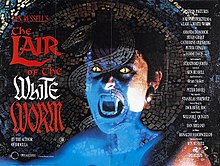
Lair of the White Worm (1988)


The Movie: Angus Flint (Peter Capaldi), a Scottish archeology student is staying at the local boarding house owned by the Trent sisters, Eve (Catherine Oxenberg) and Mary (Sammi Davis). For his thesis Flint is excavating some of the local Roman ruins, which apparently have not received much attention thus far. Is Angus in luck today, because right in the front yard of the boarding house he uncovers the ruins of a convent. Not only that, he discovers a strange skull; almost like a dinosaur, although as he points out dinosaurs and Romans missed each other by about twenty-five million years.

That evening, while attending the annual party thrown at the local lord’s castle, he learns a bit more. Eve’s boyfriend, Lord James D’Ampton (Hugh Grant, yes the Hugh Grant), has just come into his inheritance; and he explains to Angus that his ancestor, John D’Ampton, is popular in local legend for slaying the neighborhood dragon many centuries ago. In fact, the yearly party is specifically to celebrate that event. He is particularly interested to hear about Angus’ discovery.

But before James is able to see the skull; his neighbor, Lady Sylvia Marsh (the prolific Amanda Donohoe, who you may recognize from the Jim Carrey movie Liar Liar), steals it. The mysterious disappearance of the skull is only one of several peculiar incidents. When Eve comes home and touches the crucifix hanging on her wall (which Lady Sylvia spat some weird venom on while she was pilfering the skull), she is overcome by nightmarish hallucinations. Around this same time, a pocket watch that belonged to Eve and Mary’s father is found in the local caverns; and their parents disappeared without a trace a year ago. Lord James starts to wonder if the legend of his ancestor might not have some truth after all; and if his ancestor actually finished the job.

Unfortunately for our heroes, Lord James is more right than he knows. The D’Ampton Worm was actually worshipped as the god Dionan by an ancient local cult. Things get worse when Lady Sylvia kidnaps Eve. You see, Lady Sylvia Marsh is actually Dionan’s immortal, inhuman priestess; and she has been in the area since at least Roman times. Eve is not only the current Lord D’Ampton’s girlfriend, or even a virgin and devout Christian, which, of course, makes her an ideal sacrifice for Dionan; but the reincarnation of the woman who tried to build the convent over Dionan’s temple. Lady Sylvia Marsh is in the mood for some millennia old vengeance. And of course, the D’Ampton worm lays waiting for its next sacrifice…

The Review:

“My dear man, you should know by now that I change my cars as regularly as a snake sheds his skin."
-Lady Sylvia Marsh

I have long been sure that Lair of the White Worm is the main reason why my sister does not trust my movie suggestions. Back when I was a teenager over a decade ago, she came into the room when I was showing it to a friend. She was appalled at what she saw, and to this day my sister will still react if the movie is brought up.

Lair of the White Worm was based off of the novel of the same name, which was Bram Stoker’s last. It is also one of the few cases I have found where the movie is actually better than the book that inspired it. The book reads like Stoker was heavily medicating while he wrote it; although, considering that he was suffering from strokes and possibly syphilis at the time, he very well could have been.

However, considering that the film was directed by the late Ken Russell, a significant amount of that drug fueled sensibility inevitably makes it into the movie. Russell built a rep on excess and his own bizarre creative visions. Among the other examples you’ll find in this film are nightmarishly sexual, psychedelic hallucination sequences; and various subtle, and not so subtle, uses of sexual symbolism in both the back and fore ground.

Ironically, compared to other examples of Russell’s work that I’m familiar with, Lair of the White Worm is rather tame and conventional. However, considering what said body of work is like, that’s really not saying much. All throughout the film is this sense of dementia and long-repressed sexuality bubbling to the surface, to the detriment of all in its way. It mixes in weird ways to provide us in the audience with both a really warped laugh and the sensation that things are going nightmarishly out of control in ways we can’t comprehend.

At the same time though, and this is the really bizarre part, all of this dementia and lunacy is bound up in a fairly conventional plot and setting. Lair is, among other things, a very British film. The basic plot, hero rescues his girlfriend from a huge monster, fuels millions of movies. Also, the dialogue and character interaction is almost every bit what we are led to expect from a British film; polite, sedate, formal, and rather deadpan. The fact that this is true even during the most extreme scenes of psychedelic nightmare and sexual deviance creates an emotional contrast that really affects you. It’s quite a trip.

Another notable feature of this movie is Russell’s unconventional approach to conventional horror movie tropes, which covers my two favorite elements in this movie. The first is the exposition; we learn the history of the D’Ampton Worm through a source I have not seen used in any other movie, a rock band playing at James’ party. It is an extremely catchy and fun little tune; and what’s more, in a few short minutes we know everything that in most other movies we learn from ten minutes of some dry academic character talking.

The other unconventional approach that I love is the heroes’ approach to fighting Lady Sylvia and her god. All throughout the movie Lady Sylvia is depicted with snakelike features and symbols; her fangs, her ability to spit venom, one scene that has her slithering out of a huge basket. In response, the heroes take her on using conventional snake fighting and/or charming methods; bagpipes and records of snake-charmer music alongside the conventional explosives and poison gas.

Amanda Donohoe is perfect as Lady Marsh. Not only does she look the part, stylishly attractive but with a face that actually looks snakelike given the right accentuation; she really gets into the role. From her attitude and the energy Donohoe puts into the part, one gets the impression that she was having the time of her life. The role is also well written; a strong, competent, clever and ruthless villain who is nevertheless elegantly depraved and twisted enough to capture the imagination. Among the things I like best about her is her ability to adapt to the heroes’ strategies against her and form her own strategies to counter them; it’s not something you see very often in movie villains. Ultimately, she’s one of the main parts of the movie that sticks in your mind.

I wish I could be as equally impressed with the other female leads, but unfortunately they ultimately come across as your typical damsels in distress. I apologize for the mini-rant, but I really like strong women. It’s extremely frustrating for me that in the majority of movies, particularly mainstream ones, the heroines are nearly always weak, passive individuals who need the male leads to save them. Worse, on the rare occasion when a female character is strong and competent; more often than not she is depicted either as the villain, or as having something wrong with her.

The male leads are more interesting. Grant and Capaldi establish a rapport from the beginning that’s fun to watch. One thing I noticed that I found interesting is that they seem to start out with a mild but latent hostility to each other. What’s more, the way it’s played out makes me think that it’s more instinctive than conscious; the two men come from very different social backgrounds and aren’t sure what to expect from each other. However, as the movie progresses; their struggle in the face of a common foe finds them forming an equally subtle, but effective, respect for each other. Some of their exchange of dialogue is great.

I find particularly interesting the role of James D’Ampton in the fight against Lady Sylvia. Admittedly, he doesn’t confront her or the D’Ampton Worm directly; that job falls to Angus. However, it’s James who first notices something is wrong, who is able to put most of the pieces together, and who convinces the others of the threat. Also, while he doesn’t confront the villains directly, he does play an equally essential role in the conflict. I’m sure Eve, for one, is very glad that he plays his hand when he does.

Finally, I would be negligent if I failed to mention Stratford Johns in the role of James’ butler and manservant, Peters. While a very small role, Stratford captures my attention in one particular scene. For most of his time in the movie, Peters fits pretty much all the stereotypes of the proper English butler. However there is one scene, when he is discussing snake-charming music with James, where he lets the façade drop and gives a lecherous leer and tone to his voice that is just wonderful.

In short, Lair of the White Worm is a bizarre film by a bizarre director, who’s taming down of some of the perversity actually makes the rest of it stand out even more. Twisted, perversely funny, and downright weird in some aspects; this movie is a must see for a certain personality type. However, keep in mind that this isn’t a film for everyone. Even a little over a decade and a half later; my sister still looks at me suspiciously whenever I suggest a movie to her.

Tuesday, January 17, 2012

Lips of Blood (1975)


The Movie: Frédéric (Jean Rollin associate Jean-Loup Philippe), a fairly successful man, experiences a shock at the reception for the launch of a new perfume. The photograph on a poster, showing a ruined castle by the sea, triggers a memory from when he was about twelve (Frédéric as a child is played by Rollin’s son, Serge). One night, while following a dog, he got lost among some castle ruins. Inside the castle he stumbled upon a girl (European 1970s sexploitation queen Annie Belle, credited here as Annie Briand), a little older than him, who comforted him and watched over him while he slept. Frédéric instantly fell in love.

Unfortunately, he was never able to find the castle or the girl again. In fact, everyone around him has insisted that it never happened at all, that it was a childhood dream or fantasy that he had, nothing more. When Frédéric takes his mother (Natalie Perrey, who has been involved with just about every Jean Rollin film I’m familiar with, though not always in front of the camera) aside after seeing the poster, this is exactly how she responds (for, it is strongly implied, the million and first time). However, after seeing the poster, Frédéric is convinced that his experience was real after all and determined to rediscover the castle.

Frédéric starts by seeking the photographer (Martine Grimaud, who went on to become a French porn star) who took the picture and asking her about it. She at first refuses to tell him, saying that somebody paid her a lot of money not to. However, after he turns on the charm she agrees to meet him that night and give him everything she knows. Unfortunately, that is the start of a very strange and stressful night for our hero. He finds that somebody has murdered the photographer to prevent her from telling him what he wants to know. What’s more, strangers appear to impede his search, while strange visions of the girl seem to be guiding him to some end. One of the first places she leads him is a graveyard crypt, where Frédéric inadvertently releases four very beautiful, yet vicious and deadly, female vampires.

It is soon apparent that there is a conspiracy determined to keep Frédéric from succeeding in his quest. The girl and the vampires seem equally determined that he does succeed. Frédéric himself refuses to give up. Unfortunately, he has no idea how close to home for him the conspiracy lies…

The Review:

“Scents are like memories, the person evaporates but the memory remains”

Happy 2012 dear readers, albeit a little overdue. A new year! A new beginning! A new chance to accomplish things in life! And no, the Mayan calendar doesn’t actually say the world will end in December. I won’t go into the details here and now, but feel free to contact me if you really want to hear them.

For my first review of 2012 I am covering Lips of Blood, probably one of the most well known works of the late French director Jean Rollin. In fact, many consider it his masterpiece. I wouldn’t go quite that far (my personal favorites of his are Night of the Hunted and Shiver of the Vampires), but it is still a very well made and arresting piece of work.

All of the major themes Rollin liked to work with are present; love, memory, isolation, the search for answers beyond everyday life, vampirism, and having a sense of wonder of the world. There is a bit more of a streamlined, conventional plot to Lips of Blood than there is to most of Rollin’s movies, and it is a bit more accessible to a more mainstream audience; but at the same time it is still every bit as dreamy, atmospheric, haunting and emotional as one would come to expect of Rollin’s work.

Just the camera work and settings alone make this movie worth a watch. Rollin worked on a low budget, which means that he mainly shot on location; but he makes very effective work of the locations that he uses. Among other things we are presented with some very haunting shots of the castle ruins, the beach that appears in many Rollin films, a graveyard full of crypts, and various nighttime Paris locations. Many of these shots just stick with you.

However, it’s not just the settings and camera work that make this an effective movie. Much credit also needs to go to the cast and characters who drive this movie’s plot. Jean-Loup Philippe has a large responsibility as our hero and protagonist, but he pulls it off well. Unlike the only other male Rollin protagonist I can currently think of (see my November, 2011 review of Fascination), I find Frédéric to be sympathetic and identifiable. Here is a man who fully realizes that something important is missing, that the everyday world everyone tries to keep him in is unable to provide him with what he truly needs. Overall Frédéric is a good man, but he won’t let anything stand in his way to find the truth. And, while he does make a few mistakes, Frédéric ultimately proves himself to be fairly intelligent and competent.

I have seen quite a few of Annie Belle’s other movies, including the very first one she was in, Bacchanales Sexuelles/Fly Me the French Way, which Rollin directed under his Michel Gentil pseudonym. Now, I find that I often have a problem with watching Annie Belle in her movies; I tend to feel really bad about doing it. In most of her ‘70s movies Annie Belle gives off this little sister vibe (well, she’s nothing like my actual little sister, but you know what I mean), this sense of youth and innocence that makes me feel like a dirty old man; and not in a good way. It’s not until some of her later films, where she’s still gorgeous but her looks have matured a bit, that I can appreciate how sexy she is without feeling like I’m participating in the defilement of an innocent.

I tell you this so you’ll understand why when I first saw her in Lips of Blood, the sentence that kept running through my head was “it’s not just me!” Jean Rollin had to have gotten that vibe from her as well, because her character is built entirely around it. Even as we learn the dark truth of who and what the mysterious girl is, she still comes across as a childlike and sympathetic innocent; she may be a monster, but she is a monster entirely in spite of herself. The movie itself never breaks this image as well. Even though Belle does do a nude scene at the end, and one where she is making love; the camera never leers at her, never conveys the scene to us as anything other than something completely sweet and innocent.

In fact, despite being constantly categorized with the “eurosleaze” moniker, Lips of Blood really isn’t an exploitation movie at all. There is copious female nudity, this is a Rollin Picture after all, and even a bit of male nudity; but with the exception of one scene that I will get to shortly, the nudity really doesn’t come across as exploitative. It’s treated as actual art nudity, an appreciation of the human body; not just a chance to leer and ogle at bare flesh. The violence is also fairly tame, with minimum blood.

As an example of one of the perverse ironies that the gods who created this world seem so fond of, the fact that Lips of Blood is so classy is what kept it from being a commercial success. At the time it came out, movie restrictions and censorship had pretty much been dropped. Hardcore pornography was on the rise, and was threatening to edge out softcore exploitation and erotica. As a result, a quirky art film like Lips of Blood had no chance; “respectable” individuals would avoid it as sleaze, but the actual sleaze fans would be more interested in the hardcore sex films.

As I said, there is one exception to the classy nudity theme; although even it isn’t quite what it appears to be on the surface. The scene where Frédéric goes to the photographer’s studio to ask about the castle begins with a photo shoot. The photographer, wearing a robe and boots, is shooting a young woman wearing nothing but knee-high boots. The girl strikes increasingly provocative poses, until Frédéric arrives and she is dismissed. Then, after Frédéric asks the photographer about the castle, and she refuses; she goes upstairs to change for an appointment, then comes back down in nothing but her boots and a belly chain claiming she can’t find her dress. Then she agrees to tell him, propositions him, he accepts, and the scene cuts.

Now, as you can probably recognize, this scene is the reductio ad absurdum of your typical porno setup. However, “absurdum” is the key word here. Aside from the fact that there are two beautiful women in the buff (something I rarely have any problem with); the scene doesn’t come across as erotic, or even as if it’s meant to be. Instead it comes across as ridiculous to the point of being kind of funny. Knowing what I do about Rollin now, how at the time he had to crank out a lot of hardcore pornography to get the money for the projects he wanted to film; I can’t help but wonder if he wasn’t trying to make a point with this scene. If nothing else, I get the sense that he might have been using the scene to laugh at his own issues.

The final element I’d like to discuss is the vampires. Rollin had a thing with the theme of vampirism, and he liked to experiment with it in his movies. Particularly in this film, the vampires are nothing like the pop culture versions of vampires we so often think of. On the one hand, they are sexy; particularly with two of them wearing only a thin, translucent veil. However, it is equally clear that they are dangerous. There are several scenes where the vampires look at a victim with expressions of such hunger that it’s rather discomforting.

However, despite that they are sympathetic. Essentially, these vampires are extensions of Rollin’s favorite theme of isolationism. They are completely cut off from humanity; partly because of how dangerous their hunger is to others, and partly through their inability to communicate, only able to growl, snarl and scream. And at the end, when they are destroyed, despite the danger they represent there is still something incredibly sad about it.

The two vampires that most catch the attention are played by Marie-Pierre and Catherine (who I’ve heard is a successful director now) Castel, identical twins who Rollin used often, singularly and together, in his movies. If nothing else they provide a bit of humor with my two favorite moments in the film. The first is when they are leaving their crypt for the first time; one of the girls has an evil grin on her face while the other has this zombiesh expression like she still needs her coffee. The other is a scene where they break Frédéric out of a mental hospital disguised as nurses.

In the end, Lips of Blood is an art movie in the true sense of the term. It is a beautiful, sensual and haunting piece of work that invokes emotions we don’t really see much in movies anymore. If you’re into odd art movies, definitely worth seeing.